Quick answer
The best plants for a closed terrarium are humidity lovers: fittonia, mosses, ferns, peperomia, baby tears and small tropical foliage plants. The best plants for an open terrarium are the opposite: succulents, cacti, air plants and anything that wants dry air and good airflow. Getting this the wrong way round is the single most common reason terrariums fail, and it is the mistake terrarium kits sold in shops actively encourage by pairing succulents with sealed jars. Match the plant to the container type and a terrarium is close to self-sustaining.
Terrariums look effortless in photographs and are surprisingly easy to get wrong, usually within the first month.
The failure is almost never the plant’s fault. It is a mismatch between the plant and the environment it was put into. Get that one decision right and most of the rest takes care of itself.
First decide: closed or open?
Everything follows from this, so it comes before choosing a single plant.
A closed terrarium is sealed, or mostly sealed, with a lid or stopper. Moisture evaporates, condenses on the glass and runs back down. It creates a warm, humid, still environment that recycles its own water. Once balanced, it can go weeks or months without watering.
An open terrarium has no lid. Air moves freely, moisture escapes, and the environment stays dry. It needs occasional watering like a normal potted plant.
These are two completely different habitats. A plant that thrives in one will usually die in the other.
| Closed terrarium | Open terrarium | |
|---|---|---|
| Humidity | High | Low |
| Airflow | Minimal | Good |
| Watering | Rarely, once balanced | Occasionally |
| Suits | Tropical foliage, mosses, ferns | Succulents, cacti, air plants |
| Common failure | Rot from too much moisture | Drying out |
Best plants for a closed terrarium
These want humidity, low to medium indirect light, and they stay small.
Fittonia (nerve plant). The classic terrarium plant, and deservedly so. Bright veined leaves in pink, red or white, loves humidity, and it dramatically wilts when thirsty then recovers within hours, which makes it a useful early warning system for the whole container.
Mosses. Sheet moss, cushion moss and similar species form the green carpet most people picture. They need no substrate depth, they hold humidity, and they suit closed containers perfectly.
Ferns. Button fern, maidenhair and lemon button fern all work. Maidenhair fern can be demanding as a houseplant, but a consistently humid terrarium provides conditions much closer to what it prefers.
Peperomia. Compact, slow growing, and available in a wide range of leaf shapes and colours. Reliable and forgiving.
Baby tears (Soleirolia soleirolii). Tiny leaves on creeping stems, spreads into a dense mat. Grows fast, so expect to trim it.
Pilea species. Small varieties like Pilea glauca trail nicely over hardscape.
Small calathea and maranta. Prayer plants love humidity. Choose compact varieties, since full sized ones outgrow a jar quickly.
Creeping fig (Ficus pumila). Vigorous climber that will cover a back wall. Fast, so it needs regular cutting back.
Selaginella (spikemoss). Fern-like, very low growing, and one of the plants that genuinely struggles outside a terrarium because of its humidity demands.
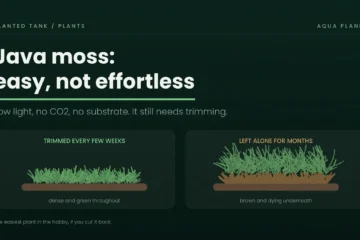
Java moss. Usually sold as an aquarium plant, but it grows emersed perfectly well in high humidity and is often used in terrariums and vivariums. It is cheap, hardy and spreads readily. Full care details are in the Java moss guide.
Best plants for an open terrarium
These generally prefer lower humidity, excellent airflow and a growing medium that dries between waterings.
Succulents. Echeveria, haworthia, sedum, jade. They store water in their leaves and need the soil to dry between waterings.
Cacti. Small varieties work well in shallow open dishes with gritty substrate.
Air plants (Tillandsia). No substrate at all. They attach to hardscape and take moisture from the air, and they need good airflow to dry out between mistings.
Aloe. Compact varieties suit open containers with bright light.
The single rule for open terrariums: gritty, fast draining substrate and no standing water at the base.
The mistake terrarium kits encourage
Walk into most shops and you will find sealed glass jars sold alongside succulents, often as a matching set.
This combination often fails. Succulents evolved in arid environments and are adapted to drying out between waterings. Sealed into a persistently humid container with little airflow, the tissue softens and rot sets in, frequently within weeks.
If a kit pairs a lid with a succulent, either remove the lid permanently or change the plant. No watering schedule can fully compensate for a sealed, persistently humid environment that does not suit an arid plant, because the problem is the conditions rather than the amount of water you added.
Plants to avoid in a closed terrarium
Most succulents and cacti. Constantly moist conditions and limited airflow increase the risk of rot, which is why they belong in an open container.
Anything that grows large. A plant that reaches two feet will be pressing against the glass in a season. Check mature size rather than the size in the pot.
Fast, aggressive growers, unless you enjoy trimming. Creeping fig and baby tears both fall here, and both are still worth using if you accept the maintenance.
Plants with very different needs, mixed together. A closed terrarium has one climate. Everything in it has to want that climate.
Layering: what goes under the plants
A closed terrarium has no drainage hole, so a drainage layer provides a separate reservoir beneath the growing medium for excess water. It does not remove water from the container, and it does not replace true drainage, so the most important thing is still to avoid overwatering in the first place.
- Drainage layer at the bottom. Lightweight expanded clay aggregate, gravel or lava rock, roughly an inch. Excess water collects here rather than sitting in the root zone, though it stays inside the sealed container.
- Mesh or barrier layer. A piece of window screen or landscape fabric keeps the substrate from washing down into the drainage layer.
- Activated charcoal, a thin scattering. Widely used to help keep a sealed container from going stale, though it is a traditional practice rather than a strict requirement.
- Substrate. A peat-free potting mix with added bark or coir works well for tropical plants. Deep enough for roots, usually two to three inches.
- Plants and hardscape. Wood, stone, and a moss surface layer if you want one.
For an open succulent terrarium, use a gritty cactus mix and skip the moss.
Light
Bright, indirect light for closed terrariums. Never direct sun.
This is not a preference, it is a safety issue. Glass concentrates heat, and a sealed container in direct sunlight will cook the plants inside within hours. The same jar in a bright spot away from the window will be fine indefinitely.
Open succulent terrariums want more light, and can take some gentle direct sun, though the glass heating problem still applies to prolonged afternoon exposure.
If your room is genuinely dark, a small LED grow light solves it.
Watering and the condensation test
This is where most people over-manage a closed terrarium.
Once sealed and balanced, a closed terrarium needs very little water. The condensation on the glass tells you what is happening:
- Light condensation that appears and clears during the day: generally a good sign that moisture is cycling through the container. Leave it alone
- Glass permanently fogged, water running down constantly: too wet. Take the lid off for a day or two to let some moisture escape
- No condensation for an extended period and the substrate visibly drying out: the terrarium may need a small amount of water, a spray rather than a pour
Condensation is a useful signal rather than a precise moisture meter, so check the substrate too rather than watering simply because the glass is not fogging. Water in small amounts either way, since there is no drainage hole and water that goes in stays in.
Open terrariums are different: water when the substrate has dried out, and let it dry again before the next watering.
Common problems
Mould or white fuzz on the substrate or wood. Very common in the first few weeks of a new closed terrarium, and usually harmless. It feeds on decaying organic matter, particularly new wood, and it typically fades as the container settles. Springtails, tiny detritivores sold for exactly this purpose, will eat it. The same thing happens in aquariums, and the mechanism is described in the white fuzzy mould guide.
Yellowing leaves. Usually too much water in a closed container, or too little light.
Leggy, stretched growth. Not enough light. The plant is reaching for it.
A plant rotting at the base. Almost always the wrong plant for a closed setup, or water pooling above the drainage layer.
Everything pressing against the glass. Trim it back. Terrarium plants are meant to be pruned, and cuttings often root readily if you want more.
Persistent smell. Something is decaying that should not be. Remove dead material and open the lid for a while.
A note on aquarium plants in terrariums
There is more crossover than most people realise, and it is worth knowing if you already keep a planted tank.
Many aquarium plants are grown emersed at the nursery, meaning above water, before they are ever sold for submerged use. That is why they often melt when first put in a tank. It also means they are perfectly capable of growing in a humid terrarium.
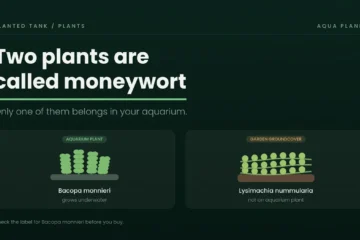
Java moss, Bucephalandra, Anubias and Cryptocoryne all grow emersed in high humidity. So does moneywort, Bacopa monnieri, which is amphibious and flowers when grown above the waterline.
This is the basis of a paludarium, a container that combines a water section with a planted land section. If you already have aquarium plants, you likely already own good terrarium plants.
Frequently asked questions
What are the best plants for a closed terrarium? Fittonia, mosses, small ferns, peperomia, baby tears, selaginella and compact prayer plants. All want high humidity, low to medium indirect light, and stay small.
Can you put succulents in a closed terrarium? It is a poor match. Most succulents need airflow and a substrate that dries between waterings, and persistently moist, still conditions raise the risk of rot. Use an open container instead.
Do terrarium plants need drainage? Closed terrariums have no drainage hole. A layer of gravel or clay aggregate acts as a reservoir for excess water below the substrate, but it does not remove water from the container, so avoiding overwatering matters more than the layer itself.
How much light does a terrarium need? Bright, indirect light. Never direct sun, since glass traps heat and can cook the plants inside within hours.
How often should you water a closed terrarium? Rarely. Once balanced it recycles its own moisture and may go weeks or months. Use the condensation on the glass as your guide rather than a schedule.
Why is there white mould in my terrarium? Usually harmless growth on decaying organic matter, common in new setups and especially on fresh wood. It normally fades as the container matures, and springtails will consume it.
Can aquarium plants grow in a terrarium? Many can. Java moss, Anubias, Bucephalandra, Cryptocoryne and Bacopa monnieri all grow emersed in high humidity, which is why they suit terrariums and paludariums.
How long do terrarium plants last? A well matched closed terrarium can run for years with occasional trimming. The limiting factor is usually plants outgrowing the container rather than dying.
Final word
Choose the container type first, then the plants. Sealed and humid means tropical foliage, ferns and mosses. Open and dry means succulents, cacti and air plants.
Almost every failed terrarium comes down to that one decision being made backwards, usually because a kit paired a lid with a plant that needed air.
Get it right, keep it out of direct sun, resist the urge to water a sealed container on a schedule, and a terrarium will largely look after itself.