Quick answer: A 20 gallon is one of the best tank sizes you can own. It is big enough to run a real community, small enough to fit in most homes, and stable enough that one missed water change will not crash it. The most important choice you will make is the shape: get the 20 long (30 x 12 x 12 inches), not the 20 high (24 x 12 x 16 inches), for most fish, because the longer footprint gives far more swimming and bottom space for the same amount of water. Plan for around 225 pounds once it is filled, cycle it before adding fish, and stock a planned community rather than a random handful of fish.
Why a 20 gallon is such a good size
Twenty gallons is the size where the hobby gets genuinely fun. A 10 gallon limits you to a small nano setup, and anything much bigger gets heavy and expensive fast. The 20 sits in the sweet spot.
The extra water volume also makes the tank more forgiving. In a small tank, a bit of overfeeding or a skipped water change can spike your parameters quickly. Twenty gallons dilutes those swings, so beginners get more room to learn without the fish paying for every mistake. It is the size most experienced keepers point new hobbyists toward once they are ready to move up from a starter tank.
20 gallon tank dimensions and weight
Not all 20 gallon tanks are the same shape, and the shape matters more than the label. Here are the common versions.
| Tank | Dimensions (L x W x H) | Footprint | Filled weight |
|---|---|---|---|
| 20 High (standard) | 24 x 12 x 16 in | 288 sq in | about 225 lb |
| 20 Long | 30 x 12 x 12 in | 360 sq in | about 225 lb |
| 20 Frameless or rimless | around 24 x 13 x 20 in | about 300 sq in | about 225 lb |
Two things to notice. First, all of them hold the same water and weigh about the same when full, roughly 200 to 225 pounds, so your stand and floor need to handle that load. Second, the 20 long has a much bigger footprint than the 20 high, 360 square inches versus 288, even though both are “20 gallons.” That footprint is what actually matters for your fish.
20 long vs 20 high: which should you get?
For most fishkeepers, the 20 long is the better tank, and it is the shape worth going out of your way to find.
Fish use horizontal space far more than vertical space. The long tank gives your fish more room to swim side to side, more floor for bottom dwellers like corydoras, and more surface area for gas exchange. It also makes a more natural-looking aquascape, since you have width to lay out plants and hardscape.
The 20 high has its place. If your spot is narrow and you need the tank to take up less shelf width, the high works. It also suits a few tall-bodied fish and some breeding setups. But if you have the choice and the space, choose the long.
The one mistake to avoid is treating the two as interchangeable. They hold the same water, but they are not the same tank, and a stocking plan that works in a 20 long can feel cramped in a 20 high.
What you need to set up a 20 gallon
The tank is just the start. A working setup needs a few essentials.
- A filter rated for at least 20 gallons. A hang-on-back filter or a sponge filter both work well.
- A heater, around 50 watts, if you keep tropical fish.
- A light, especially if you plan on live plants.
- Substrate, either gravel or sand, or an aquarium soil for a planted tank.
- A lid or hood, since many fish jump.
- A water conditioner to remove chlorine from tap water.
Once it is set up, cycle the tank before adding any fish. Cycling grows the beneficial bacteria that break down fish waste, and it usually takes a few weeks. Adding fish to an uncycled tank is the most common way beginners lose them.
How many fish can a 20 gallon hold?
You have probably heard the old “one inch of fish per gallon” rule. Ignore it. It treats a slim one-inch tetra the same as a stocky one-inch fish, and it says nothing about waste, swimming style, or adult size.
Stock by the fish instead. Plan around each species’ adult size, how much waste it produces, and whether it schools or needs floor space. A good 20 gallon might hold a school of ten small tetras, a group of corydoras, and one centerpiece fish, and still have room to breathe. When in doubt, understock. A lightly stocked tank is cleaner, more stable, and less work, and it always looks better than an overcrowded one.
Best fish for a 20 gallon tank
A 20 gallon opens the door to most of the popular community fish. Here are strong choices by the role they play in the tank.
| Role | Good choices for a 20 gallon |
|---|---|
| Schooling fish | Neon, ember, and rummynose tetras, chili rasboras, leopard danios |
| Bottom dwellers | Corydoras, kuhli loaches, bristlenose pleco |
| Centerpiece | Honey or dwarf gourami, a betta, a pair of shell-dwelling cichlids |
| Nano and inverts | Cherry shrimp, Amano shrimp, nerite snails |
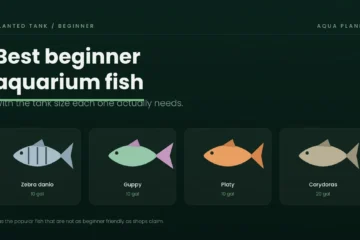
If you are brand new, start with the hardiest of these. Our guide to the best aquarium fish for beginners is a good place to pick your first stock.
Ready-made 20 gallon stocking plans
Rather than buying single fish that catch your eye, start from a plan. Here are four balanced communities that work well in a 20 gallon, ideally a 20 long.
| Community | Suggested stocking |
|---|---|
| Peaceful beginner community | 8 to 10 ember or neon tetras, 6 corydoras, 1 honey gourami, a couple of nerite snails |
| Nano shrimp and fish | 10 to 12 chili rasboras, a colony of cherry shrimp, 1 nerite snail |
| Livebearer tank | 4 to 5 platies or guppies, 6 corydoras, 1 bristlenose pleco |
| Species tank | A single betta with snails and shrimp, or a small colony of shell-dwelling cichlids in a 20 long |
Add fish in small groups over several weeks, not all at once, so your filter can keep up with the growing waste load.
What a 20 long does best
If you go with the 20 long, a few setups really shine in that footprint. Corydoras love the extra floor space and do best in groups of six or more. Kuhli loaches and other bottom fish get room to roam. Shell-dwelling cichlids can hold small territories along the length of the tank. And schooling fish get a proper runway to swim end to end, which is when their schooling behavior really shows.
Plants and decoration for a 20 gallon
A bare 20 gallon is a missed opportunity. Live plants and good hardscape make the tank look better and give your fish cover and security.
Live plants are worth it even in a low-tech setup. Hardy species like those in our low light aquarium plants guide, along with java moss, handle a basic 20 gallon easily. For the hardscape and safe decor side, see our guide to fish tank decorations. And once the tank matures and a little algae appears, our algae eater fish guide covers the cleanup crew.
Common 20 gallon mistakes to avoid
- Buying a 20 high when a 20 long would suit your fish far better.
- Adding fish before the tank has cycled.
- Overstocking because the tank “looks empty” at first.
- Putting the tank on a stand or shelf that is not rated for around 225 pounds.
- Skipping live plants and cover, then wondering why shy fish hide all the time.
FAQ
What fish can I keep in a 20 gallon tank?
Most popular community fish work: small schooling fish like tetras and rasboras, bottom dwellers like corydoras, a centerpiece such as a honey gourami or betta, and inverts like shrimp and nerite snails. A planned community of a school, a bottom group, and one centerpiece is a reliable setup.
How many fish can go in a 20 gallon?
It depends on the species, not a fixed number. Skip the one-inch-per-gallon rule and stock by adult size and waste load. A common well-stocked 20 gallon holds a school of about ten small fish, a group of corydoras, and one centerpiece. Understocking is always safer.
Is a 20 long or a 20 high better?
A 20 long is better for most fish because its larger footprint gives more swimming and bottom space for the same water volume. Choose a 20 high only if you need a narrower tank or keep tall-bodied fish.
How much does a 20 gallon fish tank weigh when full?
Around 200 to 225 pounds once filled with water, substrate, and decor. Make sure your stand and floor can support that weight.
Is a 20 gallon good for beginners?
Yes. It is one of the best beginner sizes. The larger water volume is far more forgiving of mistakes than a small nano tank, while still fitting in most homes.