Green flame moss growing upward in vertical spires on rock and driftwood in a planted aquarium

Flame Moss: How to Grow the Vertical Flame Look and Keep It

Quick answer: Flame moss (Taxiphyllum sp. “Flame”) is the aquascaping moss that grows upward, in twisting, flame-like spires, instead of sprawling sideways like most mosses. That vertical, green-campfire look is why aquascapers love it, and it is an easy, low-tech plant: attach it to a rock or piece of wood, give it low to moderate light, and it needs no CO2. The two things to get right are the ones most guides skip. To keep Read more
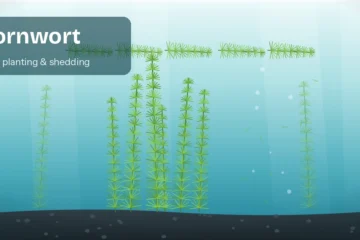
Bushy green hornwort with feathery needle whorls growing and floating in a planted aquarium

Hornwort in the Aquarium: Care, Planting, and Why It Sheds

Quick answer: Hornwort (Ceratophyllum demersum) is one of the toughest, fastest-growing, and most useful plants you can add to a tank. It has no roots, so you either float it or loosely anchor it, and it thrives in almost any conditions, from tropical tanks to unheated coldwater setups and ponds. It soaks up excess nutrients, fights algae, oxygenates the water, and gives fry and shrimp a place to hide. The one thing to expect: hornwort Read more

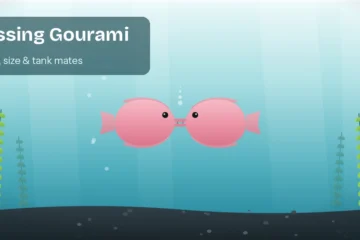
Two pink kissing gouramis lip to lip in a planted aquarium, showing their signature kissing behavior

Kissing Gourami Care: Size, Aggression, and What the “Kissing” Really Means

Quick answer: The kissing gourami (Helostoma temminckii) is a large, hardy, distinctive fish famous for the lip-locking behavior that gives it its name. Here is the first thing to know: that kissing is not affection. It is a display of dominance and aggression, usually between males squaring off over territory. The second thing: these fish grow to 8 to 12 inches, so they are not the cute little community fish they look like in the Read more

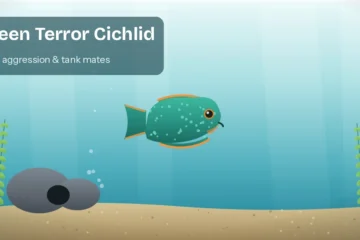
Turquoise-green green terror cichlid with orange-edged fins and a forehead hump over sand and rocks in an aquarium

Green Terror Cichlid Care: Size, Aggression, Tank Mates, and the ID Confusion

Quick answer: The green terror cichlid (Andinoacara rivulatus) is a stunning, big-personality South American cichlid, iridescent green and blue with orange-edged fins and a domed forehead on mature males. It is also, as the name warns, aggressive and territorial, and it grows to 8 to 12 inches, so it is not a beginner or community fish. It needs an experienced keeper, a large tank of at least 75 gallons, sand and rock decor it will Read more

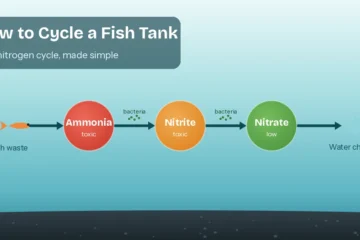
Nitrogen cycle diagram showing fish waste turning to ammonia, then nitrite, then nitrate, with water changes at the end

How to Cycle a Fish Tank: The Complete Beginner’s Guide

Quick answer: Cycling a fish tank means growing the beneficial bacteria that turn toxic fish waste into something harmless, and you do it before adding any fish. The best and kindest way is a fishless cycle: set up the tank, add a source of ammonia (bottled ammonia or a pinch of fish food), and wait while the bacteria grow to process it. Your tank is cycled when ammonia and nitrite both read zero within 24 Read more

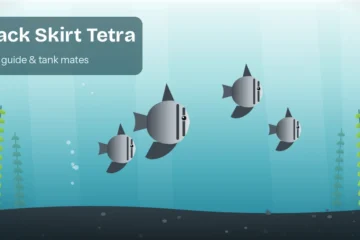
School of black skirt tetras with silver-to-black bodies and flowing black skirt fins in a planted aquarium

Black Skirt Tetra Care: Tank Mates, Size, and the Fin-Nipping Truth

Quick answer: The black skirt tetra (Gymnocorymbus ternetzi) is a hardy, active, easy schooling fish and a classic beginner community tetra, with a tall silver-and-black body and flowing fins. It is mostly peaceful, but it comes with one honest catch: black skirts nip fins, especially when kept in too small a group or housed with slow, long-finned fish like angelfish and bettas. The fix is simple. Keep them in a proper school of at least Read more

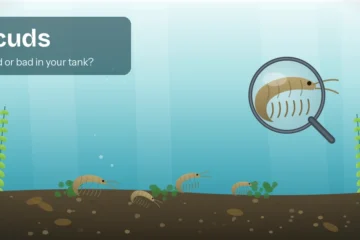
Curled comma-shaped scuds crawling through moss and substrate in an aquarium, with a magnifier showing one up close

Scuds in Aquariums: Good or Bad, and How to Control Them

Quick answer: Scuds are tiny freshwater amphipods, little comma-shaped crustaceans that look like miniature shrimp and dart around your substrate and plants. Here is the honest verdict: in most tanks they are a good thing, not a pest. They are a free cleanup crew that eats detritus and waste, and they are excellent high-protein live food your fish will happily hunt. They only become a problem in specific setups, mainly dedicated shrimp tanks, fry tanks, Read more

Large planted 150 gallon show aquarium on a stand with driftwood, plants, angelfish, and a school of fish

150 Gallon Fish Tank: Dimensions, Weight, Setup, and Stocking Ideas

Quick answer: A 150 gallon fish tank is a proper show aquarium, big enough for large fish, huge schools, or a stunning planted display, and stable enough to be forgiving once it is running. Two things people underestimate. First, “150 gallon” is not one shape. Common ones range from a long 72 by 18 by 28 inches to a tall 48 by 24 by 30, and the footprint matters more than the label. Second, a Read more

Vinegar eel culture in a jar of apple cider vinegar with apple slices and a magnifier showing the tiny eels

Vinegar Eels: How to Culture the Easiest Fry Food There Is

Quick answer: Vinegar eels (Turbatrix aceti) are tiny, harmless nematodes that make one of the best and lowest-effort first foods for baby fish. They are smaller than microworms, they swim in the water column for days without fouling the tank, and a single culture runs for months with almost no maintenance. To set one up, fill a jar with equal parts raw apple cider vinegar and dechlorinated water, add a few apple slices and a Read more

Scarlet badis with red bodies and electric blue vertical bars in a heavily planted nano aquarium

Scarlet Badis Care: Feeding, Tank Mates, and Why Yours Might Stop Eating

Quick answer: The scarlet badis (Dario dario) is a jewel of a nano fish, a tiny, fiery red-and-blue micropredator and one of the smallest fish in the hobby. It makes a stunning centerpiece for a small planted tank, but it comes with real catches. It usually refuses dry food and can quietly starve, so it needs small live or frozen foods. It is shy and easily out-competed, so it does best in a species-only tank Read more