Flame moss (Taxiphyllum sp. “Flame”) is the aquarium moss that grows straight up. Instead of sprawling sideways like java moss, it twists upward in tight, flickering spires that look like small green flames rising off rocks and driftwood. It is easy, low-tech and needs no CO2, which makes it one of the best ways to add height and movement to a nano tank, shrimp tank or aquascape. The catch is that the flame shape is not automatic. It depends on the light coming from above, steady water and a little trimming, and its slow growth means patience matters more than equipment.
This guide covers everything you need to grow flame moss well: what it is, why it grows upward, care and water parameters, how to attach it, trimming, propagation, tank mates, aquascaping ideas, how it compares with other mosses, and how to fix the problems keepers run into most.
Flame moss care stats
| Detail | Flame moss |
|---|---|
| Scientific name | Taxiphyllum sp. “Flame” |
| Family | Hypnaceae |
| Origin | East Asia |
| Growth pattern | Upright, twisting, flame-like spires |
| Height | About 3 to 4 inches (8 to 10 cm) under water |
| Growth rate | Slow |
| Light | Low to moderate, ideally from directly above |
| CO2 | Not required; improves density |
| Temperature | 68 to 82°F (20 to 28°C), best below about 77°F (25°C) |
| pH | About 6.0 to 7.5 (tolerates roughly 5.5 to 8.0) |
| Hardness | Soft to moderately hard |
| Placement | Attached to rock, driftwood or mesh; midground or accent |
| Propagation | Division |
| Difficulty | Easy, but slow |
What is flame moss?
Flame moss is an aquatic moss in the genus Taxiphyllum, the same genus as java moss. It has never been fully described as its own species, which is why it is sold as Taxiphyllum sp. “Flame”. It is thought to originate in East Asia and became popular in aquascaping because of its unusual growth habit.
Each plant is made of thin, dark green stems covered in tiny leaves. The stems grow in clusters that twist around each other as they rise, giving the moss its flame-like look. Like other aquarium mosses, it has no true roots. Instead it grips surfaces with fine, hair-like rhizoids and takes its nutrients directly from the water.
Flame moss grows both submerged and emersed. Above water, for example in a paludarium or a humid terrarium, it grows more slowly and looks bushier. It shows its full flame shape only when fully submerged.
Why flame moss grows upward
Flame moss has strong positive phototropism, meaning its shoots grow toward the brightest light source. In a tank lit from above, each cluster reaches straight up and the spires twist around one another, creating the classic flame look. This is the part most care sheets skip, and it explains nearly every “my flame moss doesn’t look like flames” complaint.
Light from above is the key. When the light comes evenly from the top, the spires rise together in neat, parallel clusters. In a dim corner, under an overhang or in a tank mostly lit from the side, the shoots lose their sense of direction and flop over, and the moss starts to look like any other moss.
Water conditions matter too. Steady temperature and clean water keep the new tips healthy. Shoots that are stressed by heat or poor water often grow thin and weak rather than upright.
Trimming shapes it. Snipping off any shoots that grow sideways tells the plant to put its energy into upward growth.
Flame moss care
Tank size and setup
Flame moss suits any tank from a 5 gallon nano upward, as long as the water is stable. Because it attaches to hardscape, it does not need any particular substrate. It is a favorite in nano and shrimp tanks, and our 5 gallon fish tank guide and 10 gallon guide cover small setups where it looks especially good.
Water parameters
Flame moss is adaptable. Keep the temperature between about 68 and 82°F (20 to 28°C), with the best growth below 77°F (25°C). It handles a pH of roughly 6.0 to 7.5 well, and soft to moderately hard water. Above all, keep conditions stable. Sudden swings in temperature or chemistry are the most common reason moss browns or melts.
Lighting
Low to moderate light is plenty. Flame moss grows in the modest light of most basic aquarium LEDs and is a good match for the plants in our low light aquarium plants guide. Run the light 7 to 8 hours a day. Strong light does not make it grow much faster, but it does feed algae, which is very hard to remove from moss. Position flame moss where it gets direct, even light from above rather than under heavy shade.
CO2 and fertilizer
CO2 is not required. In a CO2-injected tank, flame moss grows denser and greener, but in a low-tech tank it still does well, just more slowly. Mosses take nutrients from the water, so a light dose of a complete liquid fertilizer once a week can help in tanks with few fish. Root tabs do nothing for moss, since it has no roots. Avoid heavy dosing, which mainly encourages algae.
Water flow
Gentle, steady flow helps a lot. It carries nutrients through the moss and stops debris settling between the spires. Strong current, on the other hand, can flatten the flames or tear pieces loose. Place flame moss where water moves gently past it rather than directly in front of a filter outlet.
Maintenance
Do a regular 20 to 25 percent water change each week, gently siphon any debris that settles on the moss, and trim it every few weeks once it fills in. Keep loose trimmings away from the filter intake, because they can clog it or start growing inside it.
How to attach flame moss
Flame moss grows best attached to rock, driftwood or mesh. Spread a thin layer over the surface rather than a thick clump. A thick wad shades its own base, which browns and dies, and the whole patch then lifts off.
| Method | How | Best for | Notes |
|---|---|---|---|
| Cotton thread | Wrap thin moss on the surface and tie it down | Driftwood and rough rock | Breaks down in a few weeks once the moss has anchored |
| Fishing line | Same as thread | Any hardscape | Does not break down; hidden as the moss grows over it |
| Superglue gel | Small dots of gel glue, press moss on for a few seconds | Vertical surfaces, small stones | Fast and neat; use gel, not liquid, and very little |
| Mesh | Sandwich or tie moss onto stainless steel or plastic mesh | Moss walls and backgrounds | Good for covering large areas |
Expect the rhizoids to start gripping in about 3 to 4 weeks, and a firm hold within a couple of months. Until then, keep the moss in place and avoid moving the piece it is attached to. Our fish tank decorations guide covers which woods and rocks are safe to use.
How I attach moss to steel mesh
This is the mesh method I use in my own tanks. The moss in these photos is Christmas moss, but flame moss goes on the exact same way. The only difference is that flame moss will grow straight up off the mesh instead of spreading flat.
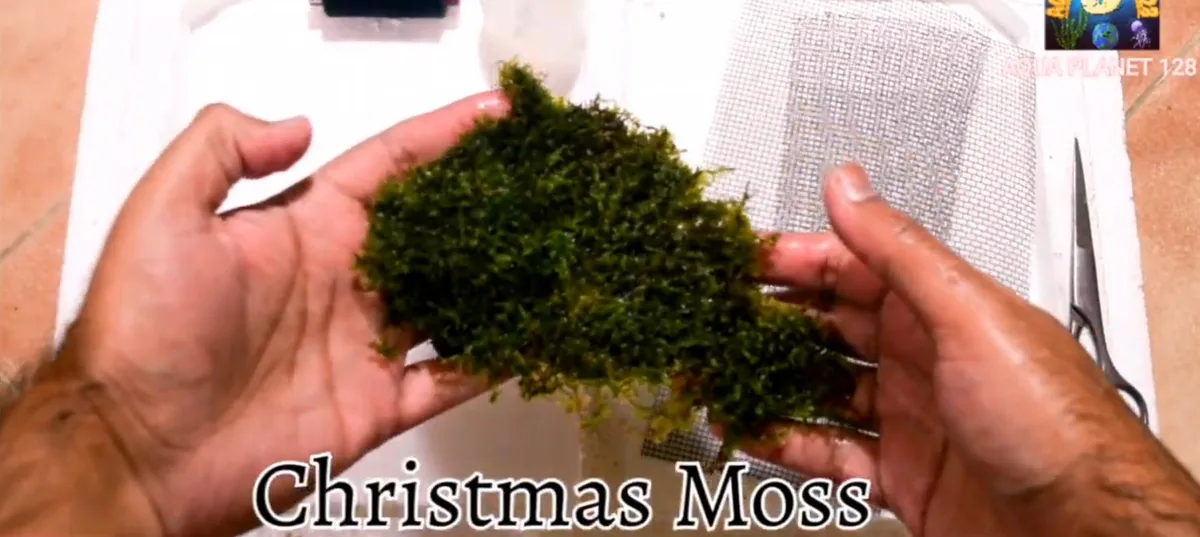
Step 1. Pull the moss apart into a thin, even layer. If you can’t see your fingers through it in places, it’s too thick.
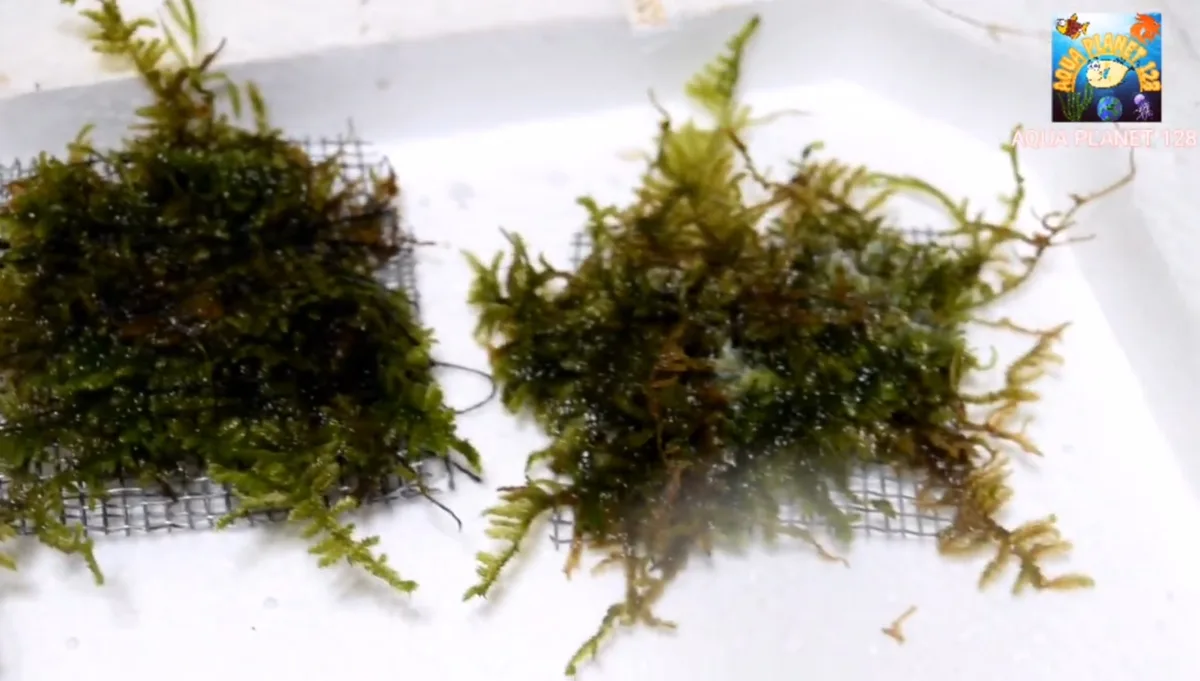
Step 2. Lay the moss across a square of stainless steel mesh. Tie it down with cotton thread or fishing line, or place a second square of mesh on top.
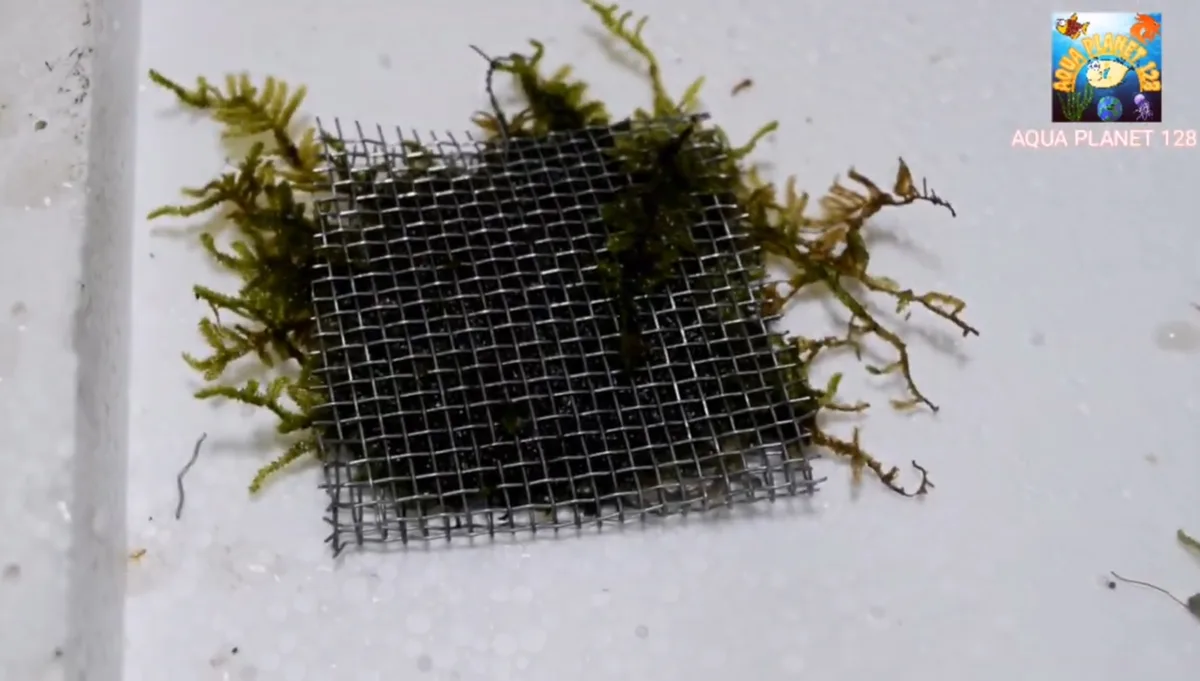
Step 3. If you use two squares, press them together and twist the corner wires so the moss stays trapped between them. New growth pokes through the holes within a few weeks, and the mesh disappears under the moss.
You can watch the whole process, with three ways to attach moss to mesh, in my video:
Trimming flame moss
Trimming keeps the flames neat, encourages new upward shoots and removes old growth before it browns.
- When. Every 6 to 8 weeks, or when the spires get taller than about 3 to 4 inches or start to look shaggy.
- How. Use sharp, curved aquascaping scissors and cut back about a third to a half of the height. Remove any stray horizontal shoots at their base.
- After trimming. Siphon or net out every loose piece. Floating bits of moss spread around the tank and can clog filters.
Regular trimming also keeps light and flow reaching the base, which is the best protection against browning and algae.
How to propagate flame moss
Flame moss is easy to propagate by division.
- Cut or pull off a healthy section of moss, ideally from an established patch.
- Spread it thinly on a new rock, piece of wood or mesh.
- Attach it with thread or a dab of gel glue.
- Keep it under even light from above and wait. New growth usually appears within 3 to 4 weeks.
Trimmings from your regular cuts are perfect for starting new patches, so one small portion can slowly cover several pieces of hardscape.
Buying flame moss: portions, cups and what to check
Flame moss is usually sold in three forms.
- Loose portions. A small bag or tub of moss. The cheapest option and the most flexible, since you attach it wherever you like.
- Tissue culture cups. Grown in sterile gel, free of snails, algae and pests. They cost more per gram but are the safest choice, especially for shrimp tanks.
- Pre-attached. Already growing on a small rock, a piece of driftwood or a mesh pad. Easy, but you pay for the hardscape too.
What to check. Healthy flame moss is a deep, even green with no brown patches, no hair algae tangled in it and a fresh smell. Look for the upright, twisted tips that set it apart from java moss. Rinse loose portions well and inspect them for snails and eggs before adding them to your tank. Our snail eggs guide shows what hitchhiker clutches look like.
How much to buy. A portion about the size of a golf ball covers a small rock or a 4 to 6 inch (10 to 15 cm) piece of driftwood when spread thinly. Because it grows slowly, buy enough to cover the area you want from the start rather than waiting for a tiny piece to spread.
Flame moss tank mates
Flame moss is safe with almost any peaceful aquarium life, and it is especially good in shrimp tanks.
| Great with flame moss | Use caution |
|---|---|
| Cherry shrimp and Amano shrimp | Goldfish, which tear and eat moss |
| Small schooling fish like neon tetras and galaxy rasboras | Large cichlids that dig and uproot decor |
| Bettas and honey gouramis | Large plecos that rasp across hardscape |
| Nerite snails and small corydoras | Very warm tanks above about 82°F |
Shrimp love flame moss because the dense fronds grow biofilm that baby shrimp graze on constantly, and the spires give shrimplets safe cover from fish.
Aquascaping ideas with flame moss
Flame or fire effect. Attach small clumps along the top of a rock or a branch so the spires rise like a campfire. This works especially well in the center of a nano scape.
Vertical driftwood accents. Upright branches covered in flame moss look like tiny trees. Because it grows up rather than out, it keeps the shape of the wood.
Rock faces and walls. Glue thin patches across a rock face or onto mesh for a textured green wall with upward movement.
Foreground interest. A few small mossy stones in the front of a tank add height and texture without blocking the view.
Carpets. You can grow flame moss on mesh across the substrate, but its upright growth makes a bumpy, textured carpet rather than a flat lawn. For a smooth carpet, dwarf sagittaria or a true carpeting moss works better.
Flame moss vs java moss vs other aquarium mosses
| Moss | Growth direction | Speed | Look | Best use |
|---|---|---|---|---|
| Flame moss | Upward, twisting | Slow | Vertical spires | Accents, height, fire effect |
| Java moss | All directions | Fast | Loose, bushy | Easy cover, fry and shrimp tanks |
| Christmas moss | Outward in layers | Moderate | Triangular, fir-like fronds | Walls, driftwood |
| Weeping moss | Downward | Slow to moderate | Drooping branches | Overhangs, tree scapes |
| Peacock moss | Outward, fan-shaped | Moderate | Dense, rounded fans | Foreground and rock cover |
Choose flame moss when you want an upright feature that adds height. Choose java moss when you just want fast, forgiving green cover. One thing to watch: sellers sometimes mislabel java moss as flame moss, because young portions look alike. If your “flame moss” spreads flat and fast instead of rising, it is probably java moss.
Common flame moss problems
Growing sideways or losing the flame shape. Almost always uneven light, side lighting or too little light. Move it where light falls evenly from above and trim off sideways shoots.
Turning brown underneath. Usually a layer attached too thickly or poor flow, so the base gets no light or circulation. Thin it out, improve gentle flow and remove dead parts.
Algae in the moss. Too much light, too many nutrients or debris settling. Lower the light intensity or duration, keep up water changes and improve flow. Once hair algae or black beard algae gets into moss it is very hard to remove, so prevention matters. Amano shrimp help keep it clean.
Melting or dying back. Often a tank that runs too warm, or a sudden change in temperature or water chemistry. Keep it below about 80°F and change water gradually.
Not attaching. Usually a smooth surface or a patch that keeps moving. Use thread or gel glue and leave the piece undisturbed for a few weeks.
Barely growing. Normal for flame moss. Expect slow progress, especially without CO2. A little liquid fertilizer and steady conditions help.
White fuzz on new moss. Usually harmless biofilm feeding on damaged bits after planting. See our white fuzz guide.
FAQ
Why is my flame moss growing sideways instead of upward?
Flame moss grows toward the light, so it grows sideways when light comes from the side or is too dim. Give it even light from directly above and trim off horizontal shoots, and new growth will rise upward.
Does flame moss need CO2?
No. It grows well in low-tech tanks without CO2. Injected CO2 makes it grow denser and faster, but it is optional.
How fast does flame moss grow?
Slowly. Expect a few weeks before you see new growth after attaching it, and a couple of months before a patch looks established.
How do I attach flame moss to driftwood or rock?
Spread a thin layer over the surface and tie it on with cotton thread or fishing line, or use small dots of gel superglue. Keep the layer thin so the base gets light.
Can flame moss be used as a carpet?
It can be grown on mesh over the substrate, but it makes a bumpy, upright carpet rather than a flat one. It looks better as an accent on hardscape.
How do I keep algae out of flame moss?
Use low to moderate light for 7 to 8 hours a day, keep nutrients in check with weekly water changes, give it gentle flow and trim regularly. Amano shrimp help graze the surface clean.
How do I propagate flame moss?
Cut off a small healthy section and attach it to a new rock or piece of wood with thread or gel glue. It will grow into a new patch over a few weeks.
Is flame moss good for shrimp tanks?
Yes, it is one of the best. The dense spires give baby shrimp cover and grow the biofilm they feed on.
What is the difference between flame moss and java moss?
Flame moss grows upward in twisting spires and is slow, while java moss sprawls in every direction and grows fast. They are in the same genus, and young portions can look similar, so they are sometimes mislabeled.
Can flame moss grow out of water?
Yes, in high humidity, such as in a paludarium or a closed terrarium. It grows more slowly and looks bushier, and it only shows the true flame shape under water.
Final thoughts on flame moss
Flame moss is one of the most striking plants you can add to a low-tech aquarium. Attach it thinly to rock or wood, give it even light from directly above, keep the water cool and stable, and trim it every couple of months. It will not race to fill the tank, but given time it forms the upright green flames that make it a favorite in aquascapes and shrimp tanks alike.