Quick answer
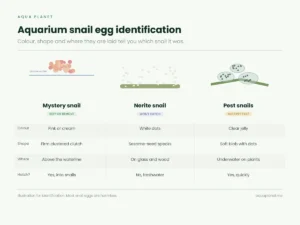
Aquarium snail eggs are identified by their colour, shape, and where they are laid. A firm pink or cream clutch above the waterline is from a Mystery snail. Tiny white sesame-seed dots stuck to hard surfaces are Nerite snail eggs, and they will not hatch in freshwater. Clear jelly-like blobs on the glass, plants, and decorations are usually from pest snails such as bladder, pond, or ramshorn snails, and these hatch quickly and multiply. Most snail eggs are harmless to fish, shrimp, and plants. Whether you keep or remove them depends on which snail laid them.
You spot a strange jelly blob on the glass, or a cluster of little dots on a leaf, and the first question is always the same: what laid this, and is it a problem?
Usually it is not a problem. Snail eggs are harmless to your fish, shrimp, and plants. But which snail laid them decides whether you leave them, hatch them on purpose, or scrape them off, so identification is the part that actually matters. Here is how to tell them apart.
How to identify aquarium snail eggs
The three things that tell you which snail laid the eggs are colour, shape, and location. Use those together and most clutches are easy to place.
Mystery snail eggs
Look for: a firm, clustered clutch of pink, orange, or cream eggs, laid above the waterline.
Mystery snails are the one type that lays eggs out of the water. The female crawls above the surface and deposits a solid clutch on the glass or under the rim, roughly the size and shape of a small cluster of berries. The colour starts bright pink or peach and, as the clutch develops, it often fades and the eggs take on a drier look before hatching. The clutch should never be submerged, or the developing eggs usually fail. If you see a firm coloured clump above the water, it is almost certainly a Mystery snail.
These are wanted eggs for most keepers. If you do not want more Mystery snails, you can simply remove the clutch.
Nerite snail eggs
Look for: tiny, hard, white or cream dots, like sesame seeds, stuck individually to hard surfaces.
Nerite snails scatter small white egg capsules across glass, wood, rocks, and equipment. They are firm little specks and they are famously stubborn to scrape off.
Here is the useful part: Nerite eggs will not hatch in a freshwater tank. Nerite larvae need brackish or saltwater to develop, so in a normal freshwater aquarium the eggs simply sit there and never become snails. They are harmless. The only downside is cosmetic, since the white dots can be hard to remove from the glass.
Pest snail eggs (bladder, pond, and ramshorn)
Look for: clear or slightly cloudy jelly-like blobs, containing tiny dots, stuck to glass, plants, and decorations under the water.
This is the type most people are actually looking at when they panic. Bladder, pond, and ramshorn snails all produce very similar clear jelly egg sacs, so most hobbyists can treat them as one group without needing to tell them apart. The sacs look like a small blob of jelly with specks inside, laid underwater, often on the underside of leaves or on the glass. Clear jelly egg sacs on aquarium glass are most commonly from bladder, pond, or ramshorn snails.
These hatch quickly and the snails multiply fast, which is why they get called pests. They are not harmful in themselves. Bladder snails and the others eat algae, uneaten food, and decaying plant matter, and they generally do not eat healthy plants. But if your tank is overfed, their numbers can explode, and that population boom is really a sign of excess food rather than a snail problem.
Ramshorn eggs look similar but the snails are flatter and coiled like a tiny wheel. Pond snails are close cousins of bladder snails. For identification purposes, treat all three the same: clear jelly sacs underwater, fast to multiply.
Are aquarium snail eggs harmful?
In almost all cases, no.
They do not harm fish. Snail eggs are not parasites or a disease.
They do not harm shrimp. Snails and shrimp share the same cleanup role and coexist fine.
They do not harm plants. Bladder, pond, and ramshorn snails feed on algae and decaying matter, not healthy living leaves.
What a sudden wave of pest snail eggs does tell you is that there is plenty of food in the tank, usually from overfeeding. So a population boom is worth reading as a feeding signal, not a disease. It is the same overfeeding that drives a bloom of detritus worms, another harmless sign the tank has more waste than it needs.
Should you keep or remove them?
It depends entirely on which snail laid them.
Mystery snail eggs: keep them if you want more, remove the clutch if you do not. Since they are laid above the waterline in one firm clump, they are easy to take out.
Nerite snail eggs: you can leave them, since they will not hatch in freshwater. Remove them only if the white dots bother you cosmetically.
Pest snail eggs: this is the judgment call. A few bladder or ramshorn snails are a genuinely useful cleanup crew and many keepers leave them. If you do not want them multiplying, remove the visible egg sacs and, more importantly, cut back on feeding so their population cannot boom.
How to control pest snail eggs
You do not need chemicals, and snail-killing products can harm shrimp and other invertebrates, so avoid them unless you have no livestock to protect. The mechanical approach works.
Feed less. This is the real lever. Pest snails multiply on excess food. Remove the food source and the population cannot explode.
Remove egg sacs by hand. Wipe visible jelly blobs off the glass and leaves during maintenance.
Check new plants before adding them. Most pest snails are introduced as tiny snails or egg masses hitchhiking on new plants, decorations, or other aquarium items. Inspecting or rinsing new plants stops most of them getting in. New plants can also bring in white fuzzy mold, so a new addition is worth a look either way.
Consider a natural predator. Assassin snails eat pest snails, and some fish will eat the eggs. Bear in mind assassin snails are effective but may also prey on other snails you actually want to keep, so this is a bigger decision than a quick fix.
Be patient. Once feeding is under control, the population settles rather than keeps growing.
Common mistakes to avoid
Panicking and dosing chemicals. Harmless eggs do not justify treatments that can wipe out shrimp and beneficial life.
Assuming every egg is a pest. Mystery and Nerite eggs are wanted or harmless. Identify before you scrape.
Overfeeding. The single biggest driver of a pest snail boom. More food means more snails.
Trying to remove Nerite dots aggressively. They will not hatch anyway. Scrubbing hard risks scratching the glass for no reason.
Adding fish just to eat snails without research. Some fish that eat snails have their own care needs and can create a new problem.
FAQ
What do aquarium snail eggs look like? It depends on the snail. Mystery snail eggs are firm pink or cream clutches above the waterline. Nerite eggs are tiny white sesame-seed dots on hard surfaces. Pest snail eggs, from bladder, pond, or ramshorn snails, are clear jelly-like blobs laid underwater on glass and plants.
Are aquarium snail eggs harmful to fish or shrimp? No. Snail eggs are not parasites and do not harm fish, shrimp, or plants. They are a normal part of a tank with snails in it.
How long do aquarium snail eggs take to hatch? Pest snail eggs such as bladder and ramshorn usually hatch within one to a few weeks. Mystery snail eggs take a couple of weeks. Nerite eggs will not hatch at all in freshwater.
How did snail eggs get in my tank? Most are introduced as tiny snails or egg masses hitchhiking on new plants, decorations, or substrate from another tank. This is very common and not a sign you did anything wrong.
Do bladder snail eggs mean my tank is dirty? Not on their own. A sudden boom in pest snail eggs usually points to overfeeding or excess waste, which is worth addressing, but a few snails are a normal and useful cleanup crew.
Will Nerite snail eggs take over my tank? No. Nerite eggs cannot hatch in freshwater, so they will never multiply into more snails in a normal aquarium. The white dots are only a cosmetic issue.
How do I stop pest snails multiplying? Feed less, remove visible egg sacs by hand, and check new plants before adding them. Cutting the food supply is the most effective step, since pest snails only boom when there is excess food.
Final word
Before you scrape anything off, work out which snail laid it. A firm pink clutch above the water is a Mystery snail. White sesame-seed dots are Nerite eggs and will not hatch in freshwater. Clear jelly blobs underwater are pest snails, harmless but quick to multiply if you overfeed.
Most snail eggs are harmless and some are useful. The only real action is deciding whether you want them, and if you do not, feeding less and removing the eggs by hand rather than reaching for chemicals.