Quick answer: A 100 gallon fish tank holds about 379 liters of water, and the most common size is 60 x 18 x 21 inches (152 x 46 x 53 cm), a 5 foot tank. Other popular versions measure 72 x 18 x 18 inches (6 feet long and low) or 48 x 24 x 20 inches (4 feet long and deep). Set up with water, substrate and decor, it weighs roughly 1,000 to 1,100 pounds, so it needs a stand rated for the weight and a solid floor. It’s a great size for large planted community tanks, angelfish, discus and medium cichlids. The thing most people get wrong is assuming there’s one standard 100 gallon tank. There isn’t, so always check the footprint before you buy a stand or plan your fish.
A 100 gallon tank sits in a sweet spot. It’s big enough to keep water very stable and hold fish that would never fit in a 55 gallon, but it still fits in most living rooms, unlike a 6 foot, 150 gallon monster. This guide covers every common shape, the real weight, cost, equipment and stocking ideas that actually work.
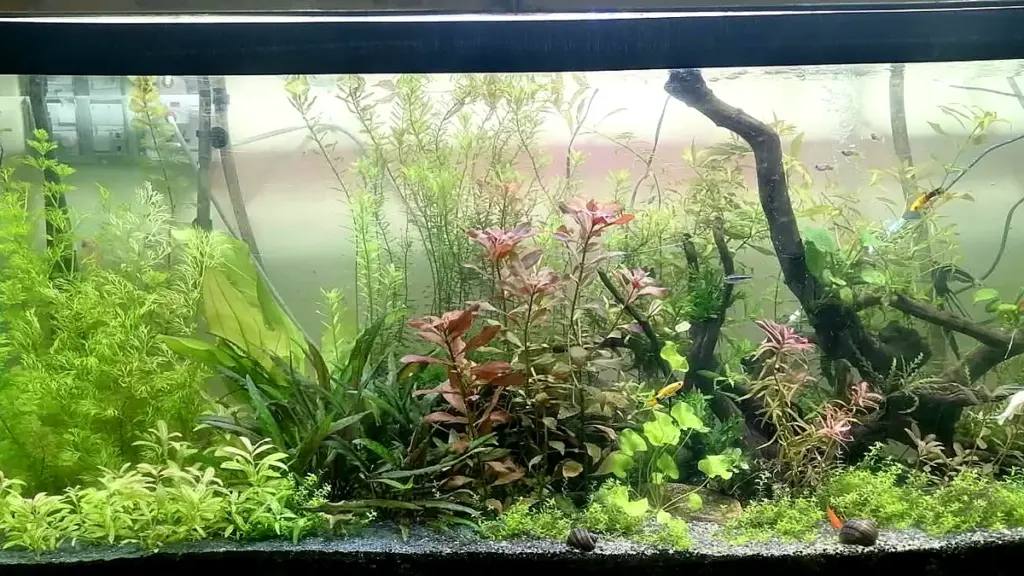
This is my own 100 gallon tank. It’s the classic 60 x 18 x 21 inch size, set up as a CO2-injected planted community tank with Rotala, red Ludwigia, Limnophila, Cryptocoryne, an Amazon sword, Hydrocotyle and a carpet plant, plus neon tetras, livebearers and mystery snails. It runs on a canister filter in the stand, and everything below is based on what a tank this size really needs.
Here’s a short video of this same tank from my YouTube channel, AQUA PLANET 128:
100 gallon fish tank at a glance
| Detail | 100 gallon fish tank |
|---|---|
| Volume | 100 US gallons (about 379 liters) |
| Most common size | 60 x 18 x 21 in (152 x 46 x 53 cm) |
| Other common sizes | 72 x 18 x 18 in, 48 x 24 x 20 in, 48 x 18 x 30 in |
| Length in feet | 4, 5 or 6 feet, depending on the style |
| Empty weight (glass) | About 150 to 250 lb (68 to 113 kg) |
| Filled weight | About 1,000 to 1,100 lb (450 to 500 kg) |
| Filter flow | About 400 to 600 gallons per hour (GPH) |
| Heater | About 300 to 500 watts total, ideally split between two heaters |
| Weekly water change | 20 to 25 percent, about 20 to 25 gallons |
| Best for | Large community tanks, angelfish, discus, rainbowfish, medium cichlids, big planted scapes |
| Skill level | Beginner friendly once set up, but a big upfront job |
100 gallon fish tank dimensions by style
Because 100 gallons isn’t one of the classic US standard sizes like the 55 or 75, every brand builds its own version. These are the shapes you’ll actually find for sale. I’ve checked each one with the standard formula: length x width x height in inches, divided by 231, gives US gallons.
| Style | Inches (L x W x H) | Centimeters | Feet | Real volume |
|---|---|---|---|---|
| 5 foot standard (most common) | 60 x 18 x 21 | 152 x 46 x 53 | 5 x 1.5 x 1.75 | About 98 gal (371 L) |
| 6 foot long and low | 72 x 18 x 18 | 183 x 46 x 46 | 6 x 1.5 x 1.5 | About 101 gal (382 L) |
| 4 foot deep | 48 x 24 x 20 | 122 x 61 x 51 | 4 x 2 x 1.67 | About 100 gal (378 L) |
| 4 foot tall | 48 x 20 x 24 | 122 x 51 x 61 | 4 x 1.67 x 2 | About 100 gal (378 L) |
| 4 foot extra tall | 48 x 18 x 30 | 122 x 46 x 76 | 4 x 1.5 x 2.5 | About 112 gal (424 L), often sold as a “100” |
These are inside or close-to-inside measurements, and real tanks vary by an inch or so. Always use the maker’s listed outside dimensions when you buy a stand or a lid. You can check any tank’s volume with our aquarium volume calculator.
Here’s the honest part most guides skip, including some that rank at the top of Google. You’ll find articles that “calculate” a 100 gallon tank as 47 inches on each side or a cube with 7 inch sides. Those numbers come from mixing up liters and inches. A real 100 gallon cube would be about 28.5 inches on every side, since 28.5 x 28.5 x 28.5 divided by 231 is roughly 100. If a size doesn’t pass the divide-by-231 check, don’t trust it.
Which 100 gallon shape is best?
The shape changes what you can keep far more than the gallon number does.
5 foot standard (60 x 18 x 21). The best all-rounder. The extra foot of length over a 4 foot tank gives schooling fish and active swimmers real room, and 21 inches of height is still easy to reach for planting and cleaning. It’s the size I chose for my own planted tank, and at 18 inches front to back there’s still enough depth for a layered scape with tall stem plants at the back.
6 foot long and low (72 x 18 x 18). The most swimming length for the volume. Great for fast schooling fish like rainbowfish, danios and barbs, and easy to aquascape and maintain since you can reach the bottom without a ladder.
4 foot deep (48 x 24 x 20). The widest footprint front to back. Excellent for aquascaping, since you get real depth for a layered scape, and for territorial cichlids that need floor space. It fits a common 48 x 24 stand.
4 foot tall (48 x 20 x 24 or 48 x 18 x 30). Best for tall-bodied fish like angelfish and for a small room. Tall tanks are harder to light all the way to the bottom and harder to clean, so they suit tall plants and simple hardscape best.
100 gallon vs 75, 125 and 150 gallon tanks
| Tank | Typical size (inches) | Footprint | Filled weight | Good for |
|---|---|---|---|---|
| 75 gallon | 48 x 18 x 21 | 4 x 1.5 ft | About 850 lb | Big community tanks, medium cichlids |
| 100 gallon | 60 x 18 x 21 | 5 x 1.5 ft | About 1,000 to 1,100 lb | Longer schools, angelfish, discus groups |
| 125 gallon | 72 x 18 x 21 | 6 x 1.5 ft | About 1,400 lb | Large schools, bigger cichlids |
| 150 gallon | 72 x 18 x 28 | 6 x 1.5 ft | About 1,700 to 1,800 lb | Large cichlids, showpiece tanks |
If you’re torn between a 75 and a 100, the 5 foot 100 gallon is usually worth it for active fish, since you gain a whole foot of length. If your space only fits 4 feet, a 75 gallon or a 4 foot deep 100 gallon makes more sense. See every size side by side in our fish tank sizes chart.
How much does a 100 gallon fish tank weigh?
Water alone weighs about 8.34 pounds per gallon, so 100 gallons of water is about 834 pounds. Add the glass, 100 to 150 pounds of substrate, rock and wood, and a set-up tank lands around 1,000 to 1,100 pounds. Heavy rockwork can push it higher.
Stand. Use a stand built for your exact tank footprint and rated for at least 1,100 pounds. The tank’s bottom frame must rest fully and evenly on the stand. Furniture, desks and DIY stands without proper bracing are not safe at this weight.
Floor. Place the tank against a load-bearing wall where you can, and run its length across the floor joists rather than along them. Ground floors and concrete slabs are best. In an apartment or an older house, ask a contractor before filling a tank this size.
Level. Check the stand with a spirit level before you add water. On a tank this size, a small tilt puts uneven stress on the seams.
Moving it. Never move a filled or partly filled 100 gallon tank. Drain it completely, remove the substrate and use at least two or three people for the empty tank.
How much does a 100 gallon fish tank cost?
Prices vary a lot by brand, glass type and where you live, so treat these as rough US ranges to help you budget.
| Option | Rough price range | Notes |
|---|---|---|
| Glass tank only, new | About $300 to $800 | Low-iron “starfire” glass costs more |
| Tank with stand | About $700 to $1,500 | Cabinet stands cost more than open metal stands |
| Complete setup | About $1,000 to $2,500 or more | Tank, stand, filter, heaters, light, substrate and decor |
| Used tank and stand | Often $200 to $700 | Check carefully for leaks and scratches |
Buying used. Large used tanks can be great value, but test them first. Fill the tank outdoors or in a garage and leave it for 24 to 48 hours, check every seam for drips, and look for silicone that’s peeling or cloudy. Don’t buy a tank you can’t leak-test.
The running costs add up too. Expect to spend on electricity for heaters and lights, water conditioner, fish food and replacement filter media every month.
Equipment for a 100 gallon fish tank
Filter. Aim for a total flow of about 4 to 6 times the tank volume per hour, so roughly 400 to 600 GPH. Most keepers use one large canister filter rated for 100 gallons or more, or two smaller canisters for backup. Big hang-on-back filters work too, often in pairs. Sumps are another great option for tanks this size.
Heater. Plan on about 3 to 5 watts per gallon, so 300 to 500 watts total. Use two heaters of 200 to 250 watts each, one at each end. Two heaters spread warmth evenly, and if one fails, the other keeps the tank from crashing.
CO2 for planted tanks. CO2 isn’t required, but in a big planted tank it makes a huge difference to growth and color. I run CO2 on my own tank and check it with a drop checker, which stays green when the level is right. Our aquarium CO2 calculator helps you estimate your level.
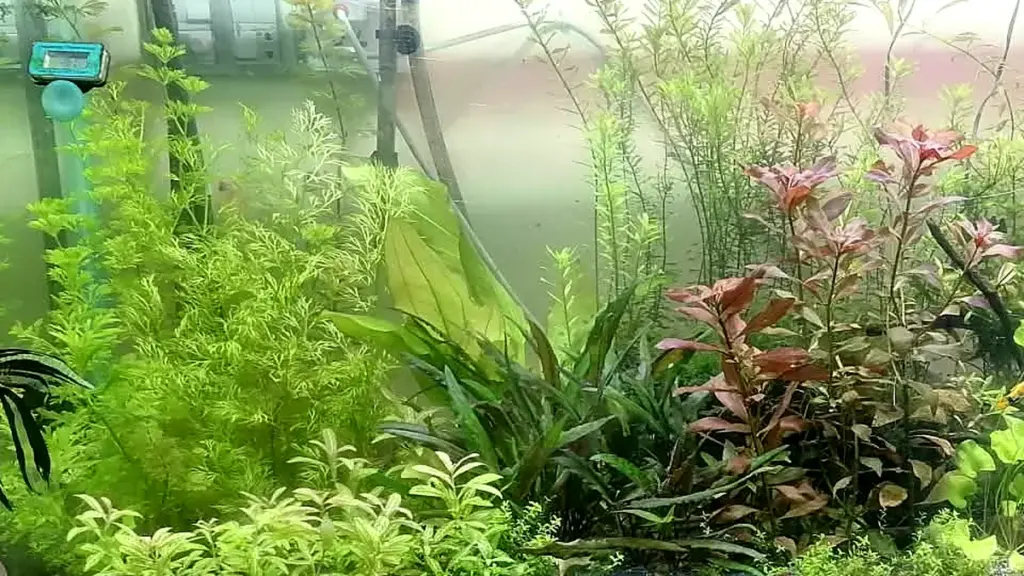
Light. Buy a light that matches your tank length: 48, 60 or 72 inches. For a planted tank, choose a light rated for your tank’s depth, especially if it’s 24 inches or taller.
Lid. A full lid cuts evaporation and stops jumpers. On a tank this size, evaporation can be several gallons a week without one.
Substrate. For a 60 x 18 inch footprint, plan on about 100 to 150 pounds for a 1.5 to 2 inch layer. Deeper planted tanks need more.
Water change tools. Carrying 25 gallons by bucket gets old fast. A long hose-style water changer that connects to a sink makes weekly maintenance much easier. Our aquarium water change calculator helps plan the amounts.
How to set up a 100 gallon fish tank
- Plan the spot. Pick a level, strong floor near outlets, out of direct sunlight, with room behind for filter hoses.
- Assemble and level the stand. Check it front to back and side to side.
- Place the empty tank and check that the frame sits evenly on the stand.
- Add substrate, rock and wood. Build the hardscape before water goes in.
- Fill slowly with dechlorinated water, pouring onto a plate or bag so the substrate stays put. Watch every seam during the first fill.
- Plant once the tank is partly filled. See our low light aquarium plants guide for easy choices.
- Start the filter and heaters, then cycle the tank for several weeks before adding fish. Our how to cycle a fish tank guide shows how.
- Add fish in stages, a group at a time over several weeks, so the bacteria can keep up.
For a full walkthrough, see our fish tank setup guide.
Best fish for a 100 gallon tank
A 100 gallon tank opens up fish that need more swimming space or bigger groups than smaller tanks can offer.
| Fish | Adult size | How many in 100 gal | Notes |
|---|---|---|---|
| Angelfish | About 6 in long, taller with fins | 4 to 6 | Best in a tank 20 inches or taller |
| Discus | About 6 in | 6 to 8 | Need warm, very clean water, around 82 to 86 F |
| Boesemani or other rainbowfish | About 3 to 4 in | 8 to 12 | Fast swimmers, love a 5 or 6 foot tank |
| Severum | About 8 in | 1 pair | Peaceful cichlid, may eat very small fish |
| Silver dollars | About 6 in | 5 to 6 | Will eat plants |
| Green terror | About 8 to 12 in | 1 or a pair | Aggressive, keep with robust tank mates |
| Neon tetras, cardinals and other small tetras | About 1.5 to 2 in | 20 to 40 | Large schools look stunning in a long tank |
| Cory catfish | About 2 to 2.5 in | 10 to 15 | Keep one species in a big group |
| Bristlenose pleco | About 4 to 5 in | 1 to 2 | Algae grazer that stays a manageable size |
| Honey gourami | About 2 in | 3 to 5 | Peaceful centerpiece for a community tank |
Angelfish are one of the best centerpiece fish for a tank this size. Here are my platinum angelfish in a planted tank:
100 gallon fish tank stocking ideas
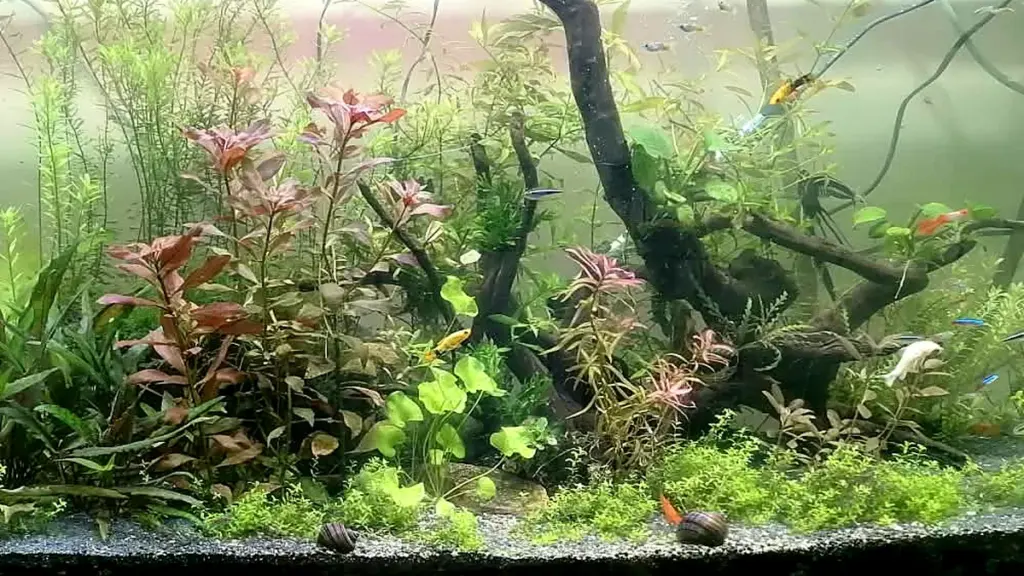
A close-up of the middle of my tank. Neon tetras school around the driftwood, and the mystery snails graze the carpet. A long tank like this lets a school of small fish spread out and actually look like a school.
These are starting points for a cycled, well-filtered tank. Add fish gradually and check any plan with our aquarium stocking calculator.
| Tank theme | Stocking idea |
|---|---|
| Planted community | 25 neon or cardinal tetras, 15 harlequin rasboras, 12 cory catfish, 3 honey gouramis, 1 bristlenose pleco, nerite snails and Amano shrimp |
| Angelfish centerpiece | 5 angelfish, 15 rummynose tetras, 10 cory catfish, 1 bristlenose pleco |
| Discus tank | 6 to 8 discus, 20 cardinal tetras, 8 sterbai corys (they handle discus temperatures) |
| Rainbowfish tank (5 or 6 foot) | 10 Boesemani rainbowfish, 10 dwarf neon rainbowfish, 10 cory catfish, 2 bristlenose plecos |
| Active barb tank | 12 tiger barbs, 10 cherry barbs, 8 clown or yoyo loaches started small, 1 bristlenose pleco |
| Central American cichlids | 1 pair of severums or 1 green terror, a school of large silver dollars, 1 bristlenose pleco |
How many goldfish can go in a 100 gallon tank?
Fancy goldfish. Orandas, ryukins, moors and other fancy goldfish are messy and grow to 6 to 8 inches. A common guideline is about 20 gallons for the first fancy goldfish and 10 to 20 more for each one after that. That makes about 4 to 6 fancy goldfish a sensible number for a 100 gallon tank with strong filtration.
Common and comet goldfish. These grow to 10 to 12 inches or more and are very active. A 100 gallon tank can hold one or two young ones for a while, but they really belong in a pond as adults.
Goldfish prefer cooler water than most tropical fish, so don’t mix them with tropical community species.
Fish to avoid in a 100 gallon tank
Common plecos. They often grow past 15 inches and produce huge amounts of waste. See our pleco fish guide for smaller alternatives.
Oscars in groups. A single oscar can live in a 100 gallon, ideally a long or wide one, but groups need much bigger tanks.
Arowanas, large catfish and big monster fish. Fish like arowanas, red-tailed catfish and large stingrays outgrow a 100 gallon tank and need custom tanks or ponds.
Mixing very different temperaments. A peaceful tetra school and a large aggressive cichlid don’t belong together, however big the tank.
Maintenance for a 100 gallon tank
| How often | Task |
|---|---|
| Daily | Check temperature, filter flow and that every fish is eating |
| Weekly | Change 20 to 25 percent of the water, vacuum the substrate, wipe the glass |
| Every 2 to 4 weeks | Rinse filter sponges in old tank water, trim plants |
| Monthly | Test ammonia, nitrite, nitrate and pH, check heater settings and hoses |
| Every few months | Clean canister impellers and hoses, replace worn filter floss |
Big tanks are more forgiving than small ones because waste is diluted in so much water, but they also hide problems longer. Testing regularly matters more, not less.
Common 100 gallon tank problems
Dead spots and debris. Long tanks can have low-flow corners where waste piles up. Point filter outlets to create a gentle loop around the tank, or add a small powerhead.
Uneven heat. One heater in a 5 or 6 foot tank leaves a cold end. Use two heaters, one at each side.
Plants not growing at the bottom. The light isn’t reaching. Upgrade to a light rated for your tank’s depth or choose low light plants.
Cloudy water after setup. Usually a bacterial bloom in a new tank. Our cloudy fish tank water guide explains what to do.
Algae. Too much light, too many nutrients or not enough plants. Cut the photoperiod to 6 to 8 hours and add fast-growing plants. Stubborn algae is covered in our black beard algae guide.
Overstocking because it’s “huge.” 100 gallons sounds endless, but large fish fill it quickly. Plan for adult sizes, not shop sizes.
FAQ
What are the dimensions of a 100 gallon fish tank?
The most common size is 60 x 18 x 21 inches (152 x 46 x 53 cm). Other popular versions are 72 x 18 x 18 inches and 48 x 24 x 20 inches, since there’s no single standard size.
How big is a 100 gallon fish tank in feet?
Usually 5 feet long, 1.5 feet wide and about 1.75 feet tall. Long versions are 6 feet long, and deep versions are 4 feet long and 2 feet wide.
How many liters is a 100 gallon fish tank?
About 379 liters. One US gallon is 3.785 liters, so 100 gallons equals 378.5 liters.
How much does a 100 gallon fish tank weigh when full?
About 1,000 to 1,100 pounds with water, glass, substrate and decor. Water alone accounts for roughly 834 pounds.
How many fish can you put in a 100 gallon tank?
It depends on adult size. Roughly 50 to 80 small community fish like tetras and rasboras, or a smaller number of larger fish like 5 angelfish or 6 to 8 discus with a school of small fish.
How much does a 100 gallon fish tank cost?
In the US, a glass tank alone usually costs about $300 to $800, and a complete setup with stand and equipment about $1,000 to $2,500 or more. Used tanks are often cheaper.
What size stand do I need for a 100 gallon tank?
One that matches your tank’s footprint exactly, such as 60 x 18 inches or 48 x 24 inches, and is rated for at least 1,100 pounds.
Can a 100 gallon tank go on a second floor?
Often yes in a well-built house, if it’s placed against a load-bearing wall and across the joists. Because it weighs over 1,000 pounds, ask a contractor if you’re unsure, especially in older homes or apartments.
Final thoughts
A 100 gallon fish tank is one of the most rewarding sizes you can choose. It’s large enough for stable water, big schools and fish like angelfish and discus, yet small enough to fit most homes. Pick the shape that suits your fish, put it on a stand rated for over 1,000 pounds, cycle it fully and stock it slowly. If you want something a little smaller, our 55 gallon fish tank guide is a good next read, and if you’re dreaming bigger, see our 150 gallon fish tank guide.