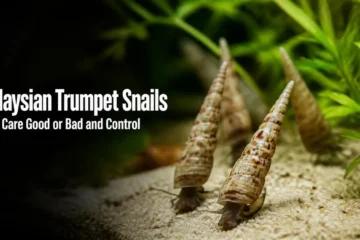
Malaysian trumpet snails with pointed cone shells crawling on aquarium sand

Malaysian Trumpet Snails: Care, Good or Bad and How to Control Them

Quick answer: Malaysian trumpet snails (Melanoides tuberculata, also called red-rimmed melania or MTS) are small, cone-shaped freshwater snails that grow to about 1 inch (2.5 cm) in aquariums and live roughly 1 to 2 years. They spend the day buried in the substrate, eat leftover food, detritus and algae, and keep sand from compacting. They’re harmless to fish, shrimp and healthy plants. Most Malaysian trumpet snails reproduce without a mate and give birth to live … Read more about Malaysian Trumpet Snails: Care, Good or Bad and How to Control Them
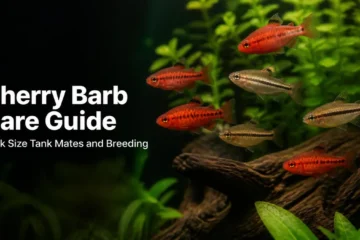
Red male and tan female cherry barbs swimming among green aquarium plants

Cherry Barb Care Guide: Tank Size, Tank Mates and Breeding

Quick answer: Cherry barbs (Rohanella titteya, formerly Puntius titteya) are small, peaceful barbs from Sri Lanka that grow to about 2 inches (5 cm) and live 4 to 6 years. Keep a group of at least 6 in a planted tank of 20 gallons or more, at 73 to 81 F with pH 6.0 to 7.5. Males turn deep cherry red, while females are tan with a dark side stripe. They’re hardy, easy to feed … Read more about Cherry Barb Care Guide: Tank Size, Tank Mates and Breeding

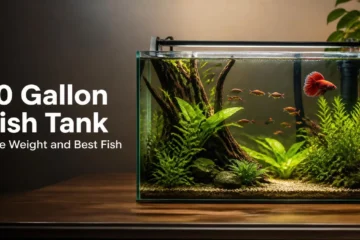
Planted 10 gallon fish tank with ember tetras and a betta on a wooden desk

10 Gallon Fish Tank: Dimensions, Weight and Best Fish to Keep

Quick answer: A standard 10 gallon fish tank measures 20 x 10 x 12 inches (51 x 25 x 30 cm), holds about 38 liters, weighs around 11 pounds empty and roughly 100 to 115 pounds once it’s filled with water, gravel and decor. It’s a good size for one betta, a small school of 6 to 8 nano fish like galaxy rasboras or ember tetras, a group of pygmy corydoras, or a shrimp colony. … Read more about 10 Gallon Fish Tank: Dimensions, Weight and Best Fish to Keep

Assassin snail with yellow and brown striped shell in a planted aquarium

Assassin Snail Care Guide: Diet, Eggs and Pest Snail Control

Quick answer: Assassin snails (Anentome helena, often sold as Clea helena) are small, striped freshwater snails that hunt and eat other snails. They grow to about 0.75 to 1 inch (2 to 2.5 cm), live 2 to 3 years, and do best at 72 to 82 F with pH 7 to 8 and hard water. They’re a natural way to control pest snails like ramshorn, bladder and Malaysian trumpet snails, and they breed slowly, so … Read more about Assassin Snail Care Guide: Diet, Eggs and Pest Snail Control

Red cherry shrimp on aquarium moss next to its clear molted shell

Shrimp Molting: How Often, Molt vs Dead and How to Fix Failed Molts

Quick answer: Shrimp molting is when a shrimp sheds its old hard shell (exoskeleton) so it can grow. Yes, all shrimp molt, and it’s a good sign. Young cherry shrimp molt about every 1 to 2 weeks and adults every 3 to 6 weeks, while Amano and ghost shrimp molt roughly every 4 to 6 weeks. A molt is a clear, empty, shrimp-shaped shell, while a dead shrimp is solid, turns pink, orange or white, … Read more about Shrimp Molting: How Often, Molt vs Dead and How to Fix Failed Molts

Golden mystery snail with a tall spiral shell climbing in a planted freshwater aquarium

Mystery Snail Care: Size, Eggs, Tank Mates and Lifespan

Quick answer: Mystery snails (Pomacea diffusa) are peaceful freshwater apple snails that grow to about 2 inches (5 cm), live around 1 to 2 years, and do best at 68 to 82 F with pH 7.5 or higher and hard water for a strong shell. One snail needs about 5 gallons, they eat algae, leftovers and dead plant matter, and they’re safe with shrimp, most fish and healthy plants. Unlike ramshorns, they have separate sexes … Read more about Mystery Snail Care: Size, Eggs, Tank Mates and Lifespan

Red and blue ramshorn snails with flat coiled shells on a green aquarium plant leaf

Ramshorn Snail Care: Eggs, Plants and How to Control Them

Quick answer: Ramshorn snails are small, flat-coiled freshwater snails, usually under 1 inch (2.5 cm), that eat algae, leftover food and dying plant leaves. They live about 1 to 2 years, handle 64 to 80 F, need hard water with pH 7 to 8 for healthy shells, and come in red, pink, blue, leopard and brown. They’re safe with fish, shrimp and healthy plants. Most people get two things wrong. First, “ramshorn” is a group … Read more about Ramshorn Snail Care: Eggs, Plants and How to Control Them

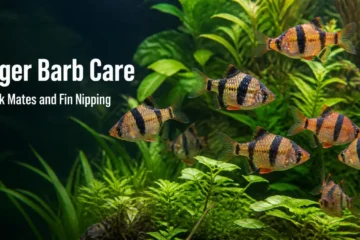
School of orange and black striped tiger barbs swimming in a green planted aquarium

Tiger Barb Care: Tank Size, Tank Mates and How to Stop Fin Nipping

Quick answer: Tiger barbs (Puntigrus tetrazona) are bold, orange and black striped schooling fish from Sumatra that grow to about 2.5 to 3 inches and live 5 to 7 years. They’re hardy and easy to feed, and they do best in a group of at least 6, ideally 8 to 12, in a 30 gallon tank or larger at 72 to 81 F. The thing most people get wrong is group size. Tiger barbs aren’t … Read more about Tiger Barb Care: Tank Size, Tank Mates and How to Stop Fin Nipping

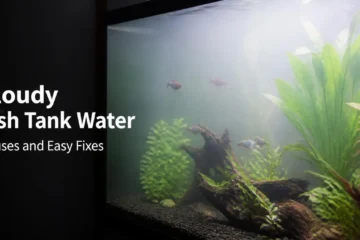
Cloudy white fish tank water in a planted aquarium with fish faintly visible through the haze

Cloudy Fish Tank Water: Causes by Color and How to Clear It

Quick answer: Cloudy fish tank water is usually caused by one of five things, and the color tells you which. White or milky water in a new tank is a bacterial bloom, which clears by itself in a few days to about two weeks. Gray water right after setup is dust from new gravel or sand. Green water is free-floating algae. Yellow or brown tint is tannins from driftwood or leaves, which are harmless. Cloudy … Read more about Cloudy Fish Tank Water: Causes by Color and How to Clear It

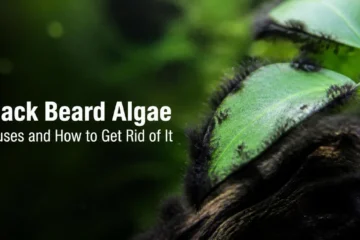
Black beard algae tufts growing on an anubias leaf and driftwood in a planted aquarium

Black Beard Algae: What Causes BBA and How to Get Rid of It

Quick answer: Black beard algae (BBA) is a red algae that grows as dark, bristly tufts on leaf edges, driftwood, rocks and filter outlets. To get rid of it, cut off the worst leaves, spot treat the rest with liquid carbon or 3% hydrogen peroxide using a syringe, and then fix the real cause, which is usually CO2 that rises and falls through the day, weak or uneven flow, and old, slow-growing leaves with organic … Read more about Black Beard Algae: What Causes BBA and How to Get Rid of It