Quick answer
Detritus worms are thin, white or tan, wiggly worms that live in aquarium substrate and feed on waste. They are generally harmless to fish, shrimp and aquarium plants. They are not parasitic worms and do not attack healthy tank inhabitants, and they are common in established tanks whether you notice them or not. A sudden bloom of them usually means overfeeding or a buildup of waste, not a disease. You control them by feeding less and cleaning the substrate, not by dosing medication. The one thing worth doing is making sure they are actually detritus worms and not planaria, which look similar but behave differently.
You did a water change, or turned off the filter for a minute, and suddenly the water is full of tiny white worms wriggling in that distinctive S-shaped swimming motion.
It looks alarming. It is not.
Detritus worms are one of the most common things new tank keepers panic about, and one of the least dangerous. I have dealt with both detritus worms and planaria in my own tanks, so this article is as much about telling them apart as it is about the worms themselves.
What detritus worms actually are
If you searched for “tiny white worms in my aquarium” or “white worms in my fish tank”, detritus worms are one of the most likely explanations.
Detritus worms are small aquatic worms that feed on decomposing organic matter and the microorganisms associated with detritus in the aquarium. In plain terms, that means waste, uneaten food, dead plant bits and fish poop, the stuff that collects at the bottom of every tank. They are usually white, cream or light tan, thin and segmented, and they live in the substrate.
They are common in established aquariums, especially tanks with substrate and available organic waste. Most of the time they live down in the substrate where you never see them, quietly doing their job as part of the tank’s cleanup crew.
You usually only notice them when something pushes them out of the substrate into open water, which is why people spot them right after a water change, a filter restart, or a substrate disturbance.
Are detritus worms harmful?
No. This is the part to hold onto.
They do not harm fish. They are not parasites. They will not attack or infect anything.
They do not harm shrimp. In a shrimp tank they are actually part of the same cleanup ecosystem.
They do not harm plants. They feed on dead matter, not living tissue.
They are not a sign of a dirty, dangerous tank on their own. They are common in established tanks, and a healthy planted tank has them too.
What a sudden bloom does tell you is that there is a lot of food for them right now. And that is useful information, because it points at something you can fix.
Why you suddenly have loads of them
A population explosion of detritus worms is a symptom, not the disease. They multiplied because you gave them a feast. The usual reasons:
Overfeeding. The single most common cause. Extra food that fish do not eat sinks and rots, and the worms bloom on it.
Waste buildup in the substrate. Detritus collecting in gravel or sand that has not been cleaned in a while.
An overstocked tank. More fish means more waste, which means more worm food.
A filter that needs cleaning. Gunk trapped in the filter is more food supply.
A new tank still finding its balance. New setups often go through a worm or algae phase while the system settles. It usually calms down on its own.
None of these are emergencies. They are all things you would want to sort out anyway for general tank health.
How to get rid of detritus worms
You do not need medication, and I would actively avoid dosing anything for these. Reaching for a chemical treatment on a harmless worm risks your shrimp and beneficial bacteria for no good reason. The fix is mechanical and simple.
Feed less. Cut the food back. Feed only what your fish finish in a couple of minutes, and skip a day if you have been overdoing it. Remove the food source and the population drops on its own.
Vacuum the substrate. Use a gravel vacuum during water changes to pull out the detritus they are living in. This physically removes both the worms and their food. If you have root feeders planted in that substrate, vacuum gently around them so you do not disturb their root tabs or tear up the roots.
Clean the filter if it is heavily clogged. Rinse the biological media gently in removed aquarium water rather than tap water, so you clear trapped gunk without killing off your beneficial bacteria. You do not need to do this every time a few worms appear.
Do regular water changes. Consistency keeps waste from building back up.
Be patient. Once the excess food is gone, the population falls back to the low, mostly invisible level a settled tank tends to sit at. You are not aiming for zero, you are aiming for back to normal.
That is genuinely it. No medication, no tearing the tank down, no scrubbing everything sterile.
The important part: are they actually detritus worms?
This is where most articles stop, and it is the part that actually matters. Several small pale worms look similar at a glance, and a couple of them are not harmless. I have dealt with both detritus worms and planaria in my own tanks, so here is how I tell them apart.
| Feature | Detritus worms | Planaria | Camallanus worms |
|---|---|---|---|
| Body | Thin, thread-like, even width | Flat and wider | Thin, red |
| Movement | Wriggling, S-shaped | Gliding along surfaces | Protrude from the fish |
| Location | Substrate and water | Glass and surfaces | Fish’s rear end |
| Harmful? | No | Can threaten shrimp | Yes, parasite |
| What to do | Reduce waste | Specific control may be needed | Medication needed |
Reading the detail below the table:
Detritus worms Very thin, thread-like, the same width along their whole length. White to tan. They wriggle and swim in a whippy S-shape when they are in open water. They live in the substrate. Harmless.
Planaria Flatter and wider than detritus worms, and they move differently. They glide slowly along the glass and surfaces rather than wriggling through the water, more like a slug than a swimmer. The classic tell is the head. Planaria often have a triangular, arrow-shaped head, sometimes with two eyespots that can look slightly cross-eyed. Planaria are generally more of a concern in shrimp aquariums, because some species may prey on vulnerable shrimplets or eggs. They point to the same overfeeding problem but need more care to remove.
Camallanus worms Worth knowing because these are the genuinely serious ones. Red, thread-like worms protruding from a fish’s rear end. These are internal parasites, not substrate worms, and they need proper treatment with a dedicated dewormer. If that is what you are seeing, it is a different situation entirely and not what this article covers.
So before you do anything, look closely. Thin, even width, whippy swimmer in the substrate is a detritus worm and you can relax. Flat, gliding, arrow head is planaria and worth handling more carefully. Red worms protruding from a fish’s rear end may point to Camallanus or another internal parasite, and should be treated as a possible parasitic infection where proper identification and appropriate treatment matter.
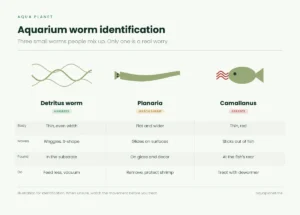
Detritus worms vs planaria: the fastest way to tell
Most people mixing these two up are looking at a small pale worm and cannot decide. If you only check one thing, check how it moves.
Detritus worms cannot glide. They wriggle. In open water they thrash in that whippy S-shape, and in the substrate they wave around anchored by one end. They are always thin and the same width from head to tail, and the head is not distinct from the body.
Planaria glide. They slide smoothly across the glass or a leaf like a tiny slug, with no wriggling at all, because they move on microscopic hairs underneath rather than swimming. Their body is flatter and wider, and the head is the giveaway: a triangular, arrow-shaped head, often with two small eyespots that make them look faintly cross-eyed.
If it is thrashing through the water, detritus worm. If it is gliding along a surface without wriggling, planaria. That single behaviour difference settles most cases before you even look at the head.
The reason it matters is not the worm itself, it is what lives in your tank. In a fish-only tank, neither is a real threat and both just mean you are overfeeding. In a shrimp tank, the difference is worth taking seriously, because some planaria can prey on shrimplets and eggs while detritus worms never will.
Should you get rid of them at all?
Honestly, not always.
If it is a mild population living in the substrate and you rarely see them, leaving them alone is a perfectly valid choice. They are part of your cleanup crew and they are processing waste for you.
The time to act is when there are so many that they are constantly visible in open water, which is really your tank telling you it is overfed. In that case you are not fixing a worm problem, you are fixing a feeding problem, and the worms just made it visible. The same overfeeding and waste that feeds a worm bloom is worth watching in your plants too, since nutrient problems show up in the same neglected tanks.
Mistakes to avoid
Dosing medication straight away. Harmless worms do not justify chemicals that can wipe out shrimp and beneficial bacteria.
Tearing the whole tank down. Completely unnecessary and it will wreck your cycle. Feed less and vacuum instead.
Assuming every small worm is the same. The whole point above. Identify before you act.
Overfeeding to compensate. Some people see the bloom, assume the fish are hungry, and feed more. That makes it worse.
Panic buying “worm treatments”. Most are aimed at parasitic worms and do nothing useful against a harmless detritus bloom while stressing everything else.
FAQ
Are detritus worms harmful to fish? No. They are not parasites and do not attack fish. They feed on waste in the substrate and are a normal part of a tank’s cleanup crew.
Where do detritus worms come from? They can be introduced with plants, substrate, decorations, water or aquarium equipment, and may go unnoticed until conditions let their population increase. You usually only see them when they multiply or get pushed into open water.
Do detritus worms mean my tank is dirty? Not necessarily. They are common in established aquariums and can be part of a healthy tank’s ecosystem, though not every tank will have a noticeable population. A sudden bloom does suggest excess food or waste buildup, which is worth addressing for general tank health.
How do I tell detritus worms from planaria? Detritus worms are thin, even-width, and swim in a whippy S-shape in the substrate. Planaria are flatter, glide slowly along surfaces, and often have a triangular arrow-shaped head. Planaria can threaten shrimp, so the difference matters.
Will detritus worms go away on their own? Often yes, once you cut back feeding and clean the substrate. Removing their food source brings the population back down to its normal invisible level.
Are detritus worms bad for shrimp? No, they are harmless to shrimp and share the same cleanup role. Planaria are the ones that can threaten shrimp, which is why identifying correctly matters.
Final word
Detritus worms look scary and are not. Thin, pale, wriggling in the substrate, harmless, and present in nearly every tank.
If they bloom, your tank is telling you it is overfed. Feed less, vacuum the substrate, clean the filter, and they settle back down on their own. Skip the medication.
The one thing worth doing is looking closely enough to be sure they are detritus worms and not planaria. Thin and whippy, you can relax. Flat with an arrow-shaped head, handle it more carefully.
1 Comment
Scuds in Aquariums Good or Bad · September 6, 2026 at 10:57 am
[…] it curls like a shrimp and swims on its side, it is a scud. For the worm-like ones, our guides to detritus worms and aquarium snail eggs cover the other things people find in a […]