Quick answer
Dwarf sagittaria (Sagittaria subulata) is a hardy, grass-like aquarium plant that spreads by runners and grows well without CO2. It tolerates a wide range of conditions, roughly 20 to 28°C (68 to 82°F) and pH 5.0 to 8.0, and grows in sand or gravel provided it gets nutrients from root tabs or an enriched substrate. The one thing most listings do not tell you: its height depends on light. Under strong light it stays around 3 to 5 inches and forms a carpet. Under low light it stretches, often to 8 inches or more, and behaves like a midground plant instead.
Dwarf sagittaria gets sold as a beginner carpeting plant, and half of that is true. It is genuinely easy, genuinely hardy, and it spreads on its own without much help.
Whether it carpets is a different question, and the honest answer depends almost entirely on your lighting. This guide covers care, planting, propagation, the problems people run into, and why the plant you bought as a foreground carpet might be growing tall instead.
Dwarf sagittaria at a glance
| Scientific name | Sagittaria subulata |
| Common names | Dwarf sagittaria, dwarf sag, awl-leaf arrowhead |
| Origin | The Americas |
| Height | 3 to 5 inches in strong light, 8 inches or more in low light |
| Light | Low to high, and height changes with it |
| CO2 | Not required |
| Temperature | 20 to 28°C (68 to 82°F) |
| pH | 5.0 to 8.0 |
| Substrate | Sand, gravel or aquasoil, with root tabs if inert |
| Growth rate | Moderate to fast |
| Propagation | Runners, spreads on its own |
| Difficulty | Easy |
What is dwarf sagittaria?
Sagittaria subulata is an aquatic plant native to the Americas, sold in the hobby as dwarf sagittaria or simply dwarf sag. It looks like short grass, with narrow strap-like leaves growing in small rosettes.
It spreads by sending out horizontal runners under the substrate, which sprout new plantlets a short distance from the parent. Left alone in decent conditions, one plant becomes a patch and a patch becomes a lawn.
That spreading habit is the main reason it is recommended to beginners. You do not need to propagate it deliberately. It does the work itself.
The height question, and why it matters
This is the part worth understanding before you buy, because it is the difference between the plant doing what you expected and not.
Under strong light, dwarf sagittaria stays short, roughly 3 to 5 inches, and puts its energy into spreading sideways. That is when it forms the dense low carpet it is marketed as.
Under low light, it stretches upward searching for more light. It can reach 8 inches or more, and instead of a foreground carpet you get a grassy midground plant.
Neither is unhealthy. The plant is fine either way. But if you have a basic light and you were expecting a flat lawn, this is why you did not get one.
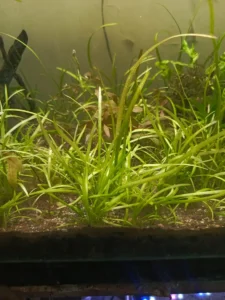
This is dwarf sagittaria in my own tank. It is dense and healthy, and it is nothing like a flat carpet. The leaves are long and grassy, and the tallest are arching over toward the surface. That is the plant doing exactly what it does under modest light, and it is worth seeing before you buy it expecting a lawn.
The practical takeaway: in a low tech tank, treat dwarf sagittaria as a midground plant that happens to spread. If you specifically want a carpet, you need stronger light, and that usually means thinking about low light versus higher tech setups more broadly.
Does dwarf sagittaria need CO2?
No. It grows perfectly well in a tank with no CO2 injection, which is a large part of why it is one of the few realistic carpet-ish options for low tech setups.
CO2 does change the result. With injection and strong light, growth is faster, denser and shorter. Without it, growth is slower and taller.
So the honest framing is that CO2 is not a requirement for the plant to live, but it is close to a requirement for a true flat carpet.
Lighting
Dwarf sagittaria tolerates low, medium and high light. Lighting does not decide whether it survives, it decides how it grows.
- Low light: survives comfortably, grows taller, spreads more slowly
- Medium light: a reasonable middle ground, moderate height, steady spread
- High light: stays short and dense, spreads faster, most likely to carpet
Around 6 to 8 hours a day is a sensible photoperiod. Running the light longer to force a carpet mostly grows algae, particularly in a tank without CO2 or fertiliser.
Substrate and nutrients
Dwarf sagittaria is a root feeder, and this is where most people go wrong with it.
Can it grow in sand? Yes. Sand is fine, and the roots hold well in it.
Can it grow in gravel? Yes, provided the gravel is not so coarse that the small roots cannot anchor.
The catch: both sand and gravel are inert. They hold no nutrients. A root feeding plant in inert substrate slowly starves, which shows up as poor growth, yellowing and a plant that never spreads.
That is what root tabs are for. Push one into the substrate near the plants and replace it periodically. In an enriched aquasoil, you may not need them at all initially.
Water parameters
It is remarkably tolerant, which is a genuine part of its beginner appeal.
- Temperature: 20 to 28°C (68 to 82°F), and it handles room temperature fluctuation well
- pH: 5.0 to 8.0
- Hardness: adapts to soft or hard water, and tolerates slightly brackish conditions better than most freshwater plants
As with most plants, stability matters more than hitting a specific figure.
How to plant dwarf sagittaria
Separate the clump. Plants usually arrive as a bunch or a pot. Gently divide them into individual rosettes rather than planting the whole clump as one.
Remove rock wool if potted. Rinse it away from the roots completely. Left in place it rots and suffocates the roots.
Trim long roots slightly. This encourages new root growth and makes planting easier.
Plant each rosette separately, spaced an inch or two apart. They will fill the gaps themselves via runners.
Bury the roots, not the crown. The crown, where the leaves emerge, should sit at substrate level. Buried crowns rot.
Use tweezers. Long aquascaping tweezers make this much easier than fingers, particularly in deeper substrate.
Spacing them out rather than planting one dense clump gives you faster overall coverage, because each plant sends runners in its own direction.
Propagation and making it spread faster
It propagates itself. Runners emerge under the substrate and new plantlets appear nearby.
To speed that up:
Give it nutrients. A starving plant does not spread. Root tabs in inert substrate are the single biggest lever.
Increase light. More light means more energy for lateral growth.
Space the initial planting out. Ten plants spread around cover ground faster than ten plants in one clump.
Trim tall leaves. Cutting back the longest leaves encourages the plant to put energy into runners rather than height.
Be patient after planting. Dwarf sag often does very little for the first few weeks while it roots, then starts spreading.
To control it rather than encourage it, simply pull up unwanted runners. It is easy to remove, unlike some spreading plants.
Common problems
Melting after planting
New dwarf sagittaria often loses its original leaves in the first week or two. They go transparent, then break down.
This is usually normal. Most aquarium plants are grown emersed, above water, at the nursery, and they shed those leaves when switching to submerged growth. If the crown and roots are firm, leave it alone and new adapted leaves will follow. This is the same process that makes Cryptocoryne melt so alarming for new keepers.
Yellowing leaves
Usually a nutrient problem rather than a light problem, and most often it means the substrate has nothing in it. Add root tabs. If yellowing continues on new growth rather than old leaves, the pattern points somewhere else and it is worth reading what the leaves are telling you.
Not spreading
Three usual causes: no nutrients in the substrate, not enough light, or simply not enough time. Dwarf sag frequently sits still for two to four weeks after planting before doing anything.
Growing tall instead of carpeting
Not a problem, just low light. Covered above. Either accept it as a midground plant or increase lighting.
Leaves turning brown or breaking down
Check for a buried crown first, since that rots. If the crown is at the right height, look at nutrients and at whether the leaves are old growth being shed naturally.
Dwarf sagittaria compared to similar plants
vs dwarf hairgrass. Hairgrass makes a finer, more convincing carpet but is fussier, generally wanting stronger light and often CO2 to carpet properly. Dwarf sag is far more forgiving and far more likely to survive a low tech tank.
vs Monte Carlo. Monte Carlo carpets low and dense but wants high light and CO2. Not a realistic low tech alternative.
vs Vallisneria. Similar grassy look, but vallisneria grows much taller, often reaching the surface. Vallisneria is a background plant, dwarf sag is foreground to midground.
vs micro sword. Similar height and use case. Micro sword is generally slower and slightly more demanding.
vs Cryptocoryne parva. Crypt parva stays smaller and is genuinely slow. Dwarf sag spreads much faster.
For a low tech tank, dwarf sagittaria and micro sword are the two most realistic options that get anywhere near a carpet.
Tank mates and compatibility
Shrimp: excellent. The grassy growth gives shrimplets cover and grows biofilm they graze on.
Betta: fine. Nothing about dwarf sag bothers a betta, and the height gives it structure to explore.
Community fish: generally fine. Most community fish leave it alone.
Goldfish: risky. Goldfish uproot and eat plants, and dwarf sag’s shallow rooting makes it an easy target.
Anything that digs: cichlids and large loaches will uproot new plantings before they root properly.
FAQ
Is dwarf sagittaria easy to grow? Yes. It tolerates a wide range of light, temperature and pH, needs no CO2, and spreads on its own by runners. The main requirement is nutrients in the substrate.
Does dwarf sagittaria need CO2? No. It grows well without CO2 injection. CO2 makes growth denser and shorter, which helps if you want a true carpet, but the plant does not need it to thrive.
How tall does dwarf sagittaria get? Around 3 to 5 inches under strong light, and 8 inches or more under low light, where it stretches upward instead of spreading flat.
Does dwarf sagittaria need root tabs? In inert sand or gravel, yes. It is a root feeder and inert substrate holds no nutrients. In an enriched aquasoil, tabs may not be needed at first.
Can dwarf sagittaria grow in sand? Yes. Sand works well for rooting. It just needs nutrients added, since sand itself provides none.
Why is my dwarf sagittaria melting after planting? Usually normal adaptation from emersed to submerged growth. If the crown and roots are firm, leave it and new leaves will grow.
How fast does dwarf sagittaria grow? Moderate to fast once established, but expect two to four weeks of little visible activity after planting while it roots.
Will dwarf sagittaria carpet without CO2? It will spread and cover ground, but in low light it tends to grow tall rather than forming a flat, dense carpet. Stronger light gets you closer without CO2.
How do I make dwarf sagittaria spread faster? Add root tabs, increase light, space the initial plants out rather than clumping them, and trim the tallest leaves to push energy into runners.
Is dwarf sagittaria the same as Sagittaria subulata? Yes. Sagittaria subulata is the scientific name, and dwarf sagittaria or dwarf sag is what the hobby calls it.
Final word
Dwarf sagittaria is one of the genuinely easy plants, and it earns the beginner recommendation. Hardy, adaptable, no CO2 required, and it spreads without being asked.
Just go in with the right expectation. In a low tech tank with modest light, it grows tall and grassy rather than flat and dense. That is not a failure, it is the plant responding to your lighting.
Give it something to feed on in the substrate, space it out when you plant it, and leave it alone for the first few weeks. After that it mostly takes care of itself.