Quick answer
Java moss is one of the easiest aquarium plants there is. It grows in low light, needs no CO2 and no substrate, tolerates roughly 15 to 30°C (59 to 86°F) and a wide pH range, and attaches itself to wood and rock with rhizoids rather than roots. You tie or glue it in place and leave it. The one thing nobody warns you about is trimming. Left alone, it grows into a thick clump that traps waste, goes brown underneath where light cannot reach, and becomes almost impossible to clean if algae gets into it.
Java moss is usually the first plant recommended to a new keeper, and the recommendation is right. It survives conditions that kill almost everything else.
What it is not is maintenance free, and that is where people run into trouble. This guide covers care, how to attach it, what it is genuinely good for, the problems that show up months later, and how to tell it apart from the other mosses sold alongside it.
Java moss at a glance
| Scientific name | Taxiphyllum barbieri |
| Also labelled as | Vesicularia dubyana, an older and misapplied trade name |
| Origin | Southeast Asia |
| Light | Low to high, thrives in low |
| CO2 | Not required |
| Temperature | 15 to 30°C (59 to 86°F) |
| pH | Roughly 5.0 to 8.0 |
| Substrate | None needed, attaches to hardscape |
| Growth rate | Slow to moderate |
| Attachment | Rhizoids, not roots |
| Propagation | Divide a clump, that is all |
| Difficulty | Very easy |
What is Java moss?
Java moss is an aquatic moss native to Southeast Asia, commonly sold as Taxiphyllum barbieri. You will also see the name Vesicularia dubyana used for it, which is an older and misapplied name still in wide circulation in the aquarium trade. That misapplication is one reason moss identification in shops can be confusing, so it is worth looking at the plant rather than relying only on the label.
It grows as a tangle of fine, branching stems covered in small overlapping leaves. There is no root system in the usual sense. It anchors itself with rhizoids, which are thread-like structures that grip a surface but take nothing from it.
That last point matters more than it sounds. It does not depend on substrate roots for nutrient uptake and can obtain what it needs from the surrounding water, so it does not care what is underneath it. Sand, gravel, bare glass, driftwood, a rock, a piece of mesh. All the same to Java moss.
Java moss care
There is not much to it, which is the appeal.
Light. Low light is fine and is what most people give it. Under stronger light it grows faster and denser, and it also becomes far more likely to catch algae. Low to moderate is the sweet spot for a low tech tank.
CO2. Not needed. It grows faster with it, like most plants, but it will never be a requirement.
Temperature. Genuinely wide, roughly 15 to 30°C (59 to 86°F). It handles cooler water better than most tropical plants, which is why it turns up in unheated tanks. It does grow more slowly and can look ragged at the top of that range.
Water parameters. Tolerant across roughly pH 5.0 to 8.0, soft or hard. As always, stability matters more than a target number.
Fertiliser. Not essential. In a tank with fish it usually gets enough from the water column. A little liquid fertiliser encourages denser growth if you want it.
Flow. Moderate flow helps, because it carries nutrients to the moss and stops detritus settling into it. Dead spots are where moss gets dirty.
https://www.youtube.com/watch?v=mfNh4TkDRoU
I covered Java moss care on camera as well, if you would rather see it than read it.
How to attach Java moss
Java moss is not planted. Burying a thick layer in substrate can cause the covered portions to deteriorate, since they receive little light and flow, and this is the most common beginner mistake with it.
Cotton thread. Wrap the moss thinly over wood or rock and tie it in place. The moss attaches within a few weeks and the cotton eventually breaks down on its own. Cheap and reliable.
Fishing line. Same method, but it does not decompose. Fine if you do not mind it staying there, since the moss grows over it.
Cyanoacrylate gel glue. A small dab of gel superglue holds moss to hardscape instantly. It is widely used in the hobby and is considered safe for aquarium use once cured. Use gel rather than liquid, and use less than feels right.
Mesh or a moss wall. Sandwich a thin layer between two pieces of plastic mesh, or tie it to one piece, then attach the mesh to the back glass or lay it flat as a carpet. This is how moss carpets and moss walls are made.
I filmed the thread method on stone as well, if it helps to see it done attaching Java moss with thread
The rule that matters: spread it thin. A thick wad tied to wood will die in the middle where no light or flow reaches. A thin layer attaches faster, grows denser, and lasts far longer.
What Java moss is genuinely good for
Shrimp tanks. This is where it earns its reputation. The dense structure gives shrimplets cover from fish, and the surface grows the biofilm that shrimp graze on constantly. If you keep Amano shrimp or other shrimp, moss is one of the most useful things you can add.
Fry cover. Livebearer fry that reach a moss clump usually survive. It is a standard trick for anyone letting guppies or platies breed in a community tank.
Spawning medium. A number of egg scattering fish will spawn into moss, and the eggs fall into it out of reach.
Softening hardscape. A bare piece of wood or rock looks new. The same piece with moss on it looks established.
Small setups and bowls. Because it needs no substrate and no equipment beyond light, moss suits very small builds. I used it as the main plant in a planted bowl aquarium on the channel.
Carpets and walls. With mesh, it makes a low tech carpet without the light and CO2 that true carpeting plants demand.
Trimming, and why it is not optional
This is the part the care sheets skip, and it is the difference between moss that looks good after a year and moss that has to be thrown out.
Java moss keeps growing outward. The outer layer gets the light and the flow. The inner layer gets neither, and over months it turns brown and dies while the outside still looks green.
Meanwhile the tangle acts as a filter, catching uneaten food and waste passing through the tank. That trapped material breaks down inside the clump.
Two things follow. The moss detaches in patches as the base dies, and the trapped material provides food for detritus worms and other decomposers, which are harmless in themselves. A large build up of organic material can still contribute to poorer tank conditions over time.
The fix is simple. Trim it back with scissors every few weeks once it thickens. Cutting it back hard is fine, it grows back readily. Trimming also encourages denser, tidier growth rather than long straggly strands.
When you trim, siphon out the debris that comes loose rather than letting it settle back into the tank.
Common problems
Algae growing in the moss
This is the real problem with Java moss, and it deserves a proper warning.
Once hair algae or black beard algae establishes itself inside a moss clump, removing it is extremely difficult. You cannot scrub moss. You cannot wipe it. Pulling algae out by hand pulls moss out with it. Spot treating means dosing directly into the plant you are trying to save.
Prevention is genuinely easier than cure:
- Keep light moderate rather than strong
- Trim regularly so light and flow reach through
- Avoid dead spots where detritus settles
- Do not overfeed
If a clump is badly infested, most keepers cut their losses, remove it, and restart with a clean piece.
Brown patches underneath
Normal die-off from lack of light in the interior. It is a sign the clump has been left too long without trimming. Cut it back and the remaining moss recovers.
It will not attach
Usually because it was tied too thickly, or because the surface is very smooth. Spread it thinner and give it a few weeks. It attaches to rough surfaces faster than glass or polished stone.
It looks straggly rather than dense
Often low light plus no trimming. Trimming is what creates density, since cutting encourages branching.
It is going everywhere
Java moss spreads from fragments. Any piece that breaks off and lands somewhere favourable will grow there. Siphon loose pieces during water changes if you want it contained.
Java moss compared to other aquarium mosses
They are sold side by side and look similar to a new keeper.
Java moss (Taxiphyllum barbieri). Irregular, sprawling growth. The cheapest, hardiest and most widely available. Best all rounder.
Christmas moss (Vesicularia montagnei). Fronds branch in a pattern often compared to fir branches. Neater and more structured than Java moss, slower growing, slightly more demanding.
Weeping moss (Vesicularia ferriei). Grows downward, which looks striking attached to the underside of wood.
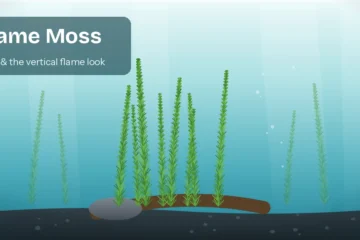
Flame moss (Taxiphyllum species). Grows upward in twisting vertical columns. Very distinctive, slower, and generally wants more light.
Peacock moss. Denser, more patterned fronds. Slower and often more expensive.
For a first moss, Java moss is the right answer. It is cheaper, tougher and more forgiving than any of the others, and if you kill it you have lost very little.
Tank mates
Shrimp: ideal, as covered above.
Small community fish: no issues, and most appreciate the cover.
Goldfish and large cichlids: risky. Both will tear moss apart, and goldfish in particular treat it as food.
Plecos and other grazers: generally fine, though some larger species will dislodge it.
Snails: fine. They graze the biofilm without damaging the moss.
FAQ
Is Java moss easy to grow? Yes, it is one of the easiest aquarium plants. It grows in low light, needs no CO2, requires no substrate, and tolerates a very wide temperature and pH range.
Does Java moss need CO2? No. It grows faster with CO2, but it thrives in low tech tanks without it.
How do you attach Java moss to driftwood? Spread it thinly over the wood and tie it with cotton thread or fishing line, or use a small dab of cyanoacrylate gel glue. It attaches with rhizoids within a few weeks. Do not bury it in substrate.
Does Java moss need to be planted in substrate? No. It has no true roots and takes nothing from the substrate. It attaches to surfaces instead, and a thick buried layer tends to deteriorate where light and flow cannot reach it.
Why is my Java moss turning brown? Usually die-off in the middle of a clump that has grown too thick for light and flow to reach. Trim it back and the healthy outer growth will recover.
How often should I trim Java moss? Every few weeks once it has thickened up. Regular trimming keeps it dense, prevents brown die-off underneath, and stops it trapping waste.
Is Java moss good for shrimp? Yes, it is one of the best plants for a shrimp tank. It provides cover for shrimplets and grows the biofilm that shrimp graze on.
How do I get algae out of Java moss? It is very difficult once established, since moss cannot be scrubbed and pulling algae out removes moss with it. Prevention through moderate light, regular trimming and good flow is far more effective. Badly infested clumps are usually replaced.
What is the difference between Java moss and Christmas moss? Java moss grows irregularly and sprawls. Christmas moss branches in a more structured, fir-like pattern, grows more slowly, and is slightly more demanding.
Is Taxiphyllum barbieri the same as Vesicularia dubyana? Not strictly. Java moss is commonly sold as Taxiphyllum barbieri, while Vesicularia dubyana is an older name that has been misapplied to it in the aquarium trade and is still widely used. Labels are not always reliable, which is part of why moss identification can be confusing.
Final word
Java moss deserves the beginner recommendation. Low light, no CO2, no substrate, and it will survive a great deal of neglect.
Just do not confuse hardy with maintenance free. Attach it thinly rather than in a wad, trim it every few weeks, and keep the light moderate. Those three habits prevent almost every problem people have with it, including the one that has no good cure, which is algae growing inside the clump.
Get those right and a single small portion will last you years, spread through your tank, and end up in every other tank you set up afterwards.