This is a sponsored post written in collaboration with Seaoura.
Choosing the right aquarium light is about more than making your tank look bright. Aquatic plants need suitable light to photosynthesize, grow new leaves, and maintain healthy growth. However, different plants have different lighting requirements, and the best setup also depends on tank depth, plant placement, CO₂ availability, and nutrient levels.
A light that works well for a low-tech aquarium may not provide enough intensity for a densely planted tank with demanding species. On the other hand, excessive light can make it harder to balance plant growth and algae.
Understanding the Lighting Needs of Aquarium Plants
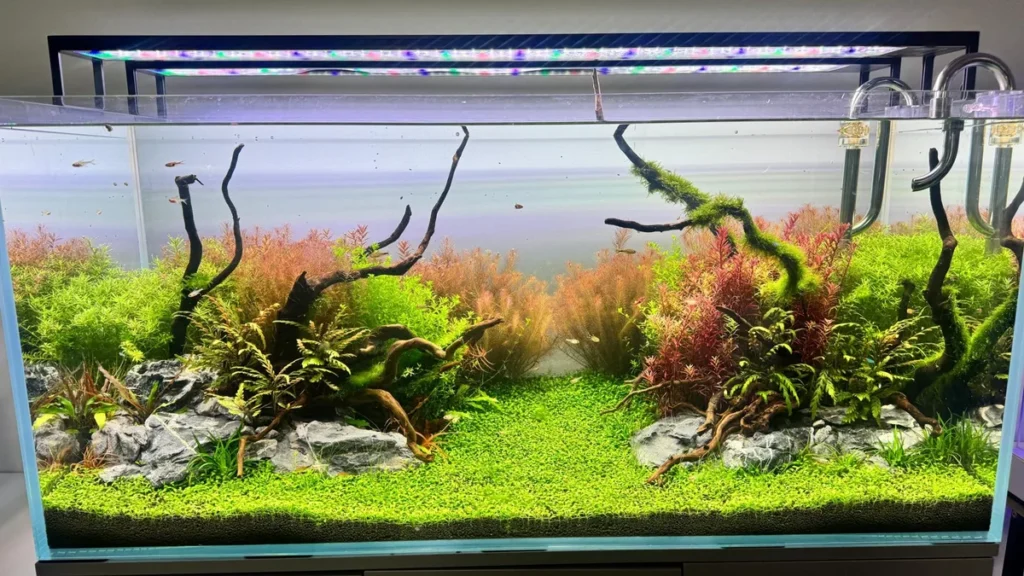
Before choosing an aquarium light, consider the types of plants you want to grow. Aquarium plants are often grouped into low-, medium-, and high-light categories. These classifications provide a useful starting point, although actual requirements vary by species and growing conditions.
- Low-light plants are generally suitable for beginners and aquariums without injected CO₂. Examples include Anubias, Java fern, and many Cryptocoryne species. These plants can grow under relatively modest lighting, although growth may be slower. See our low light aquarium plants guide for more options.
- Medium-light plants usually benefit from more consistent light and a balanced supply of nutrients. Many common stem plants and other moderately demanding species fall into this category. Depending on the plant species and setup, supplemental CO₂ may improve growth.
- High-light plants need stronger lighting to reach their full growth potential. Some carpeting plants and colorful stem plants fall into this category. However, stronger light also increases the importance of maintaining adequate CO₂ and nutrients.
Plant labels can help you estimate the difficulty of growing a particular species. For example, Tropica uses Easy, Medium, and Advanced categories to guide aquarists when selecting plants. These categories consider overall growing requirements rather than light alone.
Types of Aquarium Lights: What Are the Differences?
LED and fluorescent lights are two common options for planted aquariums. Each has different advantages depending on your tank setup and plant requirements.
| Light type | Advantages | Limitations |
|---|---|---|
| LED | Energy-efficient, long-lasting, and often adjustable | Performance and coverage vary by model |
| Fluorescent (T5/T8) | Can provide even light coverage with a suitable fixture | Bulbs need periodic replacement; controls may be limited |
LED lights are widely used in planted tanks because of their efficiency and flexibility. For more guidance on choosing a suitable fixture, see this aquarium light guide.
When comparing aquarium lights, consider light intensity, coverage, adjustability, spectrum, and tank depth. Wattage alone does not indicate how much usable light reaches your plants, and color temperature alone cannot predict plant growth.
PAR, PPFD, and Light Intensity: Understanding Aquarium Plant Lighting Needs
When choosing an aquarium light for a planted tank, it is important to consider how much light reaches your plants. PAR (Photosynthetically Active Radiation) refers to the range of light wavelengths, approximately 400–700 nanometers, that plants use for photosynthesis. PPFD (Photosynthetic Photon Flux Density) measures the number of photons within this range reaching a given area each second, expressed in micromoles per square meter per second (µmol/m²/s).
Although aquarium hobbyists often use “PAR” when discussing aquarium light intensity, PPFD is the more precise term for the numerical readings used to compare light levels at a particular location in the tank.
The following table provides rough PPFD ranges commonly used as a starting point when planning planted aquarium lighting. These are general guidelines rather than fixed requirements for every plant species or aquarium setup.
| Plant lighting level | Approximate PAR / PPFD (µmol/m²/s) | Typical examples |
|---|---|---|
| Low light | 15–30 | Anubias, Java fern, and other undemanding plants |
| Medium light | 30–50 | Many common stem plants and moderately demanding species |
| High light | 50+ | Some carpeting plants and other light-demanding species |
These ranges are approximate, and actual lighting requirements vary by plant species, aquarium depth, and growing conditions. CO₂ availability, nutrient supply, and plant acclimation also influence growth, so the table should be used as a starting point rather than a strict classification.
Measurement location matters, too. PPFD directly beneath a light fixture may differ considerably from the amount reaching plants near the substrate or aquarium edges. Tank depth, fixture coverage, floating plants, and hardscape can all affect light distribution.
If you do not have a PAR meter, start with the manufacturer’s recommendations for your aquarium size and depth. Observe plant growth over time and adjust light intensity or the photoperiod gradually. Stronger lighting does not automatically produce healthier plants, particularly when CO₂ or nutrients are insufficient.
How Long Should Aquarium Lights Stay On?
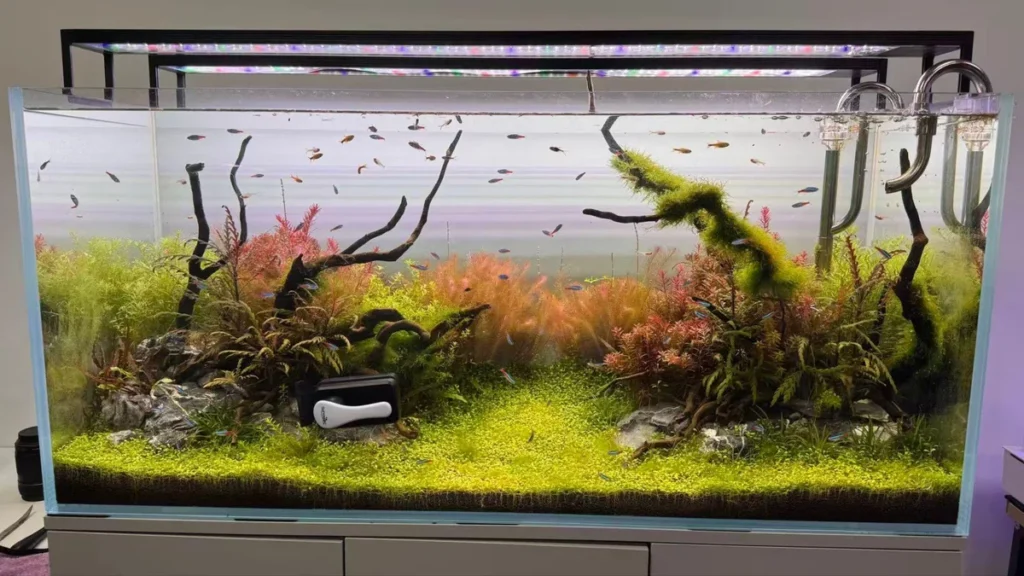
Light intensity is only part of the equation. The daily photoperiod, meaning the number of hours the light stays on, also affects plant growth and algae development.
For a newly planted aquarium, a reasonable starting point is approximately 6–8 hours of light per day. This range is a practical starting recommendation rather than a fixed requirement for every tank. Established aquariums may need a different schedule depending on plant density, light intensity, and overall balance.
Use a timer to maintain a consistent daily schedule. Consistency makes it easier to evaluate plant growth and identify whether changes in lighting are helping.
If algae begins to increase, avoid immediately making several changes at once. Review the light intensity and duration, as well as nutrient availability, CO₂, and maintenance practices. Adjust one factor at a time and allow enough time to observe the result.
Leaving aquarium lights on continuously is not necessary for healthy plant growth. Plants benefit from a regular light-dark cycle, and extending the photoperiod indefinitely does not guarantee faster growth. A stable schedule is generally more useful than simply adding more hours of light.
Lighting for Low-Tech vs. CO₂-Injected Planted Tanks
The right lighting setup also depends on whether the aquarium receives supplemental CO₂.
Low-tech planted tanks generally rely on ambient CO₂ from the aquarium environment rather than injected CO₂. These setups often work well with low to moderate lighting and undemanding plant species. Keeping light intensity and duration manageable can make the aquarium easier to maintain.
CO₂-injected planted tanks can support faster growth and a wider range of demanding plants when lighting, CO₂, and nutrients are balanced. Stronger lighting can increase the rate at which plants grow, but CO₂ availability and nutrient supply must be sufficient to support that growth. Our aquarium CO2 calculator can help you estimate your CO₂ level.
This does not mean every planted aquarium needs CO₂ injection or that every high-light setup will succeed with stronger lighting alone. The goal is to balance the available resources with the needs of the plants.
If you are building a low-tech aquarium, prioritize plants suited to modest lighting rather than purchasing the most powerful fixture available. If you want a densely planted aquascape with demanding species, consider the full setup, including CO₂, fertilization, and maintenance, before increasing light intensity.
Common Aquarium Lighting Mistakes and How to Avoid Them
Even a suitable aquarium light can produce disappointing results when its intensity, duration, or placement is poorly matched to the tank.
Using too much light too soon. Excessive light can contribute to algae problems, particularly when plant growth is limited by CO₂ or nutrients. Start with a manageable intensity and increase it gradually if the plants need more light. If stubborn algae appears, see our black beard algae guide.
Providing too little light. Insufficient light can contribute to slow growth, weak development, or elongated stems as plants grow toward brighter areas. However, these symptoms can also result from nutrient deficiencies, plant adaptation, or other growing conditions. Our aquarium plant deficiency symptoms guide helps tell them apart.
Choosing a light based on wattage alone. Wattage does not reliably indicate the light reaching your plants. Compare usable light output and coverage at your aquarium’s depth instead.
Ignoring uneven coverage. Plants directly beneath a fixture may receive much more light than those near the edges or under floating plants and hardscape. Position demanding plants where they can receive sufficient light and place shade-tolerant species in less illuminated areas.
Changing too many variables at once. If plants develop algae, pale leaves, or melting foliage, it is tempting to change the lighting, fertilizer, and CO₂ simultaneously. However, these symptoms do not always have a single cause. Check the overall conditions and adjust one factor at a time whenever practical.
Keeping the lights on for too long. Avoid extending the photoperiod unnecessarily, as longer lighting does not guarantee better plant growth.
Final Tips for Choosing the Right Aquarium Light
Before purchasing a fixture, consider these questions:
- Which plants will you grow, and how much light do they generally need?
- How deep is your aquarium, and how much light will reach the substrate?
- Does the fixture provide adequate coverage across the planted area?
- Can you adjust the brightness and maintain a consistent photoperiod?
- Are your CO₂ and nutrient levels suitable for the growth rate you want to achieve?
Choose a light suited to your plants and tank conditions, and adjust the setup gradually as your aquarium develops.
FAQs
Can regular aquarium lights grow aquatic plants?
Yes, if the light provides suitable intensity and spectrum for your plants. Undemanding species can often grow under basic aquarium lighting, while more demanding plants may need stronger or more evenly distributed light.
Can aquarium lights be too strong?
Yes. Excessive light can contribute to algae problems, especially when CO₂ or nutrients are insufficient. Adjust the intensity to match your plants and tank conditions.
Should aquarium lights be left on at night?
No. Keep aquarium lights on a consistent daily schedule and allow a regular dark period.
Do aquatic plants need red and blue light?
Plants use light across the PAR range for photosynthesis, including red and blue wavelengths. A suitable aquarium light should provide an appropriate spectrum overall; red and blue light alone do not guarantee healthy plant growth.
You can see how red and blue light look in a real aquarium in this video from my channel, AQUA PLANET 128: