Quick answer
Aquarium plant deficiency symptoms are read by looking at which leaves are damaged and what the damage looks like. Problems on old leaves usually mean a mobile nutrient is running short: yellowing old leaves can point to nitrogen deficiency, small pinholes can point to potassium, and dark or blackening leaves can point to phosphorus. Problems on new leaves point instead towards an immobile nutrient: pale or yellow new growth can point to iron, and twisted or stunted new growth can point to calcium. Symptoms overlap, so treat these as starting points, fix the cause rather than the symptom, and give the plant a few weeks of new growth before deciding it worked.
Plants cannot tell you what is wrong, so they show you.
The problem is that most deficiency guides are organised by nutrient. You have to already know the answer to find the answer. That is backwards. You are standing at the tank looking at a leaf with holes in it, and you want to know what the holes mean.
So this one is organised the way you actually look at it. Symptom first, nutrient second.
Every example below is from my own tanks. I filmed my plants while they were actually struggling rather than pulling stock photos, so what you see here is what these problems really look like in a normal home aquarium, not a competition scape.
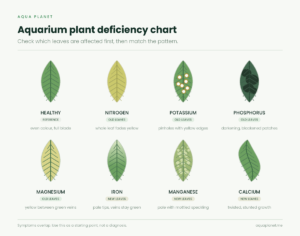
Aquarium plant deficiency symptoms at a glance
| Symptom | Most likely nutrient | Where it appears |
|---|---|---|
| Older leaves turn yellow, tips go see through | Nitrogen | Old leaves |
| Pinholes in older leaves | Potassium | Old leaves |
| Dark or blackening leaves, growth stalls | Phosphorus | Old leaves |
| Yellow between green veins | Magnesium | Old leaves |
| Pale, yellow or near white new growth | Iron | New leaves |
| Pale new growth with mottled speckling | Manganese | New leaves |
| Twisted or stunted new growth | Calcium | New leaves |
Use this to narrow it down, then read the section below for the detail, because more than one of these can be happening at once.
The one rule that narrows it down fast
Before anything else, check where the damage is.
Some nutrients move around inside the plant. When those run short, the plant pulls them out of its old leaves and sends them to the new growth, because new growth is the priority. So the old leaves suffer first.
Other nutrients cannot move once they are locked into a leaf. When those run short, the old leaves stay fine and the new growth comes in wrong.
That gives you a fast split:
- Damage on old, lower leaves points to nitrogen, potassium, phosphorus or magnesium
- Damage on new, top leaves points to iron, manganese or calcium
You have just cut the list in half by looking at one thing.
Yellow old leaves, going see through at the tips
This often points to nitrogen deficiency.
The older leaves fade to yellow, often starting at the tips, and can go pale and translucent before dropping off. New growth usually still looks fine at first, because the plant is stripping the old leaves to feed it.
Nitrogen deficiency is common in tanks with a light fish load and a lot of plants, or in tanks where the owner is doing large frequent water changes and never adding fertiliser.
What to do: dose a complete water column fertiliser containing nitrogen, or ease off slightly on water change volume if your tank is heavily planted and lightly stocked.
Small pinholes in old leaves
This can be a sign of potassium deficiency.
You get tiny holes that appear in the middle of older leaves, often with yellow or brown edges around them. Left alone, the small holes widen into ragged tears and the leaf falls apart.
People often mistake this for snail damage. The difference is that snail damage starts at the leaf edge and works inwards, and it is usually messier. Potassium pinholes appear in the middle of an otherwise intact leaf.
What to do: add potassium. Most all in one liquid fertilisers include it, and there are potassium only products if your other levels are fine.
Dark, blue green or blackening leaves with slow growth
This can point to phosphorus deficiency, though it is worth ruling out light and CO2 first, since stalled growth has several causes.
Growth stalls, colour goes darker rather than lighter, and older leaves start dying off with brown or black patches. It looks less like fading and more like burning.
What to do: dose phosphate, but avoid making large blind corrections. Algae problems are influenced by the overall balance of light, nutrients, carbon availability and plant growth, so small measured adjustments are safer than suddenly adding a large amount of any single nutrient.
Yellowing between the veins on old leaves
This often points to magnesium deficiency.
The tell is the pattern. The area between the veins goes yellow while the veins themselves stay green, so the leaf looks like a green net over a yellow background. Edges can curl.
Magnesium deficiency shows up more often in soft water tanks and in RO water setups.
What to do: add magnesium, usually as Epsom salt or as part of a remineraliser if you are using RO water.
Pale, yellow or almost white new leaves
This commonly points to iron deficiency.
The new leaves at the top come in weak and pale, sometimes near white, and often the veins stay darker than the surrounding tissue. Old leaves look completely normal, which is the giveaway.
Red plants lose their colour here too. If your Rotala or Ludwigia came in red at the shop and has faded to pale green in your tank, iron is the first thing to look at, alongside light.
What to do: dose a chelated iron supplement. Chelated matters, because plain iron becomes unavailable to plants quickly in aquarium water.
Pale new growth with mottled speckling
This can be a sign of manganese deficiency.
It looks similar to iron at a glance, which is why the two get mixed up constantly. The difference is the texture of the fading. Iron tends to pale evenly across the blade with the veins staying darker. Manganese tends to look patchy or speckled, with lighter flecks scattered between the veins rather than a smooth fade.
What to do: most complete micro fertilisers already contain manganese, so a good all in one is usually the answer rather than a manganese specific product. Given how easily this is confused with iron, dosing a full trace mix is safer than guessing between the two.
Twisted, crinkled or stunted new growth
This can be a sign of calcium deficiency.
New leaves come in deformed. Curled, crinkled, twisted or stunted, sometimes with dying tips. Again, the old leaves are fine, which points you at the new growth end of the list.
This one shows up in very soft water, where there simply is not enough calcium in the water to begin with.
What to do: test your GH. If it is very low, remineralise rather than dosing more fertiliser.
I filmed every one of these symptoms on my own plants. Photos in articles are usually the worst case example, and real tanks rarely look that dramatic, so if you are trying to match what you are seeing to what you are reading, the video will probably be more useful than the text.
What this looked like in my own tank
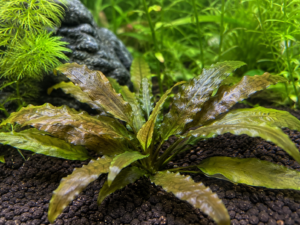
My Cryptocoryne was the plant that made me pay attention. The leaves went yellow and pale, and then black spots started appearing on them. It was not the soft transparent mush you get with melt. The leaves stayed firm, they just kept losing colour and picking up dark patches.
I started dosing mono potassium phosphate, mixed into water and added to the tank as a liquid rather than dropped in dry. That covers potassium and phosphorus, which lines up with what I was looking at, since blackening patches on older leaves point at phosphorus more than anything else.
If you go this route, dissolving it first matters. It is a raw dry salt, not a bottled fertiliser, so a few undissolved grains landing in one spot is very different from the same amount spread evenly through the water.
It took about four weeks. The damaged leaves never came back, and that is normal, so for the first couple of weeks it looked like nothing was happening. What told me it had worked was the new growth. Fresh leaves came in clean, full size and properly coloured instead of pale and spotted.
Worth being straight about this: I changed one thing and the plant recovered, which is good evidence but not proof. Tanks have a lot going on at once. What I can say is that the new growth changed and it changed after I started dosing.
Three things that look like deficiency and are not
This is where most people waste money. They start dosing harder when the actual problem is somewhere else.
New plant melt. If you just planted, and leaves are going soft, transparent and mushy within days, that is almost certainly melt rather than a deficiency. It is normal and the plant is usually fine. I wrote about that in detail in why are my aquarium plants melting.
Not enough CO2. Stunted growth, transparent lower leaves and weak new shoots can all come from carbon rather than nutrients. If your plants have adequate nutrients but still show weak or stunted growth, carbon availability is one of the next factors to investigate.
Not enough light. Stems stretching tall with big gaps between leaf nodes, and lower leaves dropping off, usually means the plant is reaching for light. No amount of fertiliser fixes that.
Where the fertiliser actually needs to go
One more thing that catches people out. Two plants with the same symptom can need two different fixes, because they do not feed the same way.
- Water column feeders like Anubias, Java fern, moss and Bucephalandra take nutrients in through their leaves. Liquid fertiliser is what reaches them.Anubias has one problem that fertiliser will not fix, and it is worth knowing the difference. If the rhizome itself is going soft rather than the leaves fading, you are looking at Anubias rhizome rot, not a deficiency.
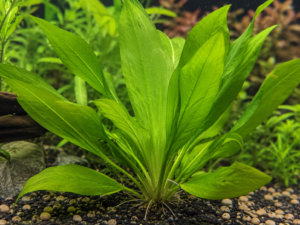
- Root feeders like Cryptocoryne, Echinodorus and Amazon sword pull most of what they need out of the substrate. Dosing the water alone often will not fix them, especially in plain sand or gravel.The same neglected substrate that starves root feeders also builds up the waste that pest blooms feed on. If you are seeing tiny white worms down there, those are usually detritus worms, harmless but a sign the tank needs cleaning.
If your struggling plant is a root feeder in an inert substrate, the fix is a root tab at the base rather than more liquid in the water. I make my own for almost nothing, and the method is in DIY root tabs for aquarium plants.
Mistakes to avoid
Diagnosing off one leaf. One damaged leaf on an otherwise healthy plant means very little. Look at the plant as a whole and look for a pattern across several plants.
Changing five things at once. If you add iron, potassium, CO2 and a new light in the same week, you will never know what worked. Change one thing and wait.
Expecting damaged leaves to heal. They will not. A leaf with holes in it stays a leaf with holes in it. Your evidence that the fix is working is what the new growth looks like, which means you need to give it two to four weeks.
Dosing more because more must be better. Excess nutrients in the water column do not get used, they feed algae. Follow the bottle, not your anxiety.
Ignoring the plant’s own habits. Some plants just drop lower leaves as they grow. That is not always a deficiency.
FAQ
[faq]
Q: How do I know if it is a deficiency or just old leaves dying?
A: Look at the new growth. If new leaves are coming in healthy and full size, the plant is fine and is simply shedding old growth. If new growth is also coming in wrong, you have a real problem.
Q: Can one deficiency cause more than one symptom?
A: Yes, and tanks often have more than one thing missing at the same time. That is why a complete all in one fertiliser is a better starting point than chasing single nutrients.
Q:How long before I see improvement?
A: Give it two to four weeks. You are waiting for new leaves, not for old ones to recover.
Q:Do low tech tanks get deficiencies too?
A: Yes, but slower. Plants grow slower without CO2 and use less, so symptoms take longer to appear and longer to correct.
Q: Are holes in leaves always potassium?
A: No. Snails, fish nipping and physical damage all make holes. Potassium pinholes start in the middle of the leaf and have yellowing edges around them.
Q: Should I test my water to find the deficiency?
A: Trace element test kits can be difficult to interpret at hobby level. Plant symptoms, water parameters, tank conditions and growth patterns are often more useful when considered together rather than relying on a single test result.
[/faq]
Final word
Look at where the damage is before you look at what the damage is. Old leaves send you towards nitrogen, potassium, phosphorus or magnesium. New leaves send you towards iron or calcium.
None of this is a certain diagnosis on its own. Symptoms overlap, and tanks often have more than one thing going on. Treat the chart as a starting point, not an answer.
Then change one thing, and judge it on the leaves that grow next, not the ones already damaged.
0 Comments