Quick answer: A betta fish tank should hold at least 5 gallons (19 liters), with a heater set to 78 to 80 F (25.5 to 26.5 C), a gentle filter, a lid, and soft plants or silk decor. A 2.5 gallon tank can keep a betta alive, but the water gets dirty and cold so fast that you spend all your time fixing it. A 10 gallon gives you room for a few peaceful tank mates or a divider for two bettas. The thing most people get wrong is thinking a betta likes a small bowl because it lives in puddles in the wild. It doesn’t. Wild bettas live in warm, shallow, heavily planted water that spreads across rice paddies and marshes, not in a cup.
Bettas are one of the first fish many of us buy, and they’re often sold in tiny cups next to tiny bowls. That setup makes them look easy. In reality a betta is a tropical fish with long, delicate fins, and it does best in a small but properly set up tank. Get the tank right once and betta care becomes some of the simplest fishkeeping there is.
I keep a small betta collection of my own and film them for my YouTube channel, AQUA PLANET 128. Here’s a look at my bettas, so you can see the different fin types and colors you’ll find in stores:
Everything below is what I’d tell a friend before they buy their first betta tank.
Betta fish tank at a glance
| Detail | Betta fish (Betta splendens) |
|---|---|
| Minimum tank size | 5 gallons (19 liters) for one betta |
| Better tank size | 10 gallons (38 liters), or more with tank mates |
| Temperature | 76 to 82 F (24 to 28 C), ideally 78 to 80 F |
| pH | 6.5 to 7.5 (they adapt to about 6.0 to 8.0) |
| Hardness | Soft to moderately hard, GH about 4 to 12 |
| Ammonia and nitrite | 0 ppm |
| Nitrate | Under 20 ppm |
| Filter | Gentle flow, sponge filter or baffled hang-on-back |
| Heater | Adjustable, about 25 watts for 5 gallons, 50 watts for 10 |
| Adult size | About 2.5 to 3 inches (6 to 7.5 cm) |
| Lifespan | Usually 3 to 5 years with good care |
| Temperament | Males fight other males; can be kept with calm tank mates |
| Diet | Carnivore: betta pellets, frozen and live foods |
| Care level | Easy once the tank is set up properly |
Bowl vs 2.5 vs 5 vs 10 gallon: which betta tank should you get?
This is where most betta problems start, so here’s an honest side-by-side.
| Setup | Heater and filter fit? | Water stability | Tank mates | Verdict |
|---|---|---|---|---|
| Bowl or vase (under 2 gallons) | Barely, or not at all | Ammonia and temperature swing daily | None | Avoid |
| 2.5 gallons (9.5 liters) | Yes, small ones | Fragile, needs frequent water changes | A single snail at most | Workable, but hard |
| 5 gallons (19 liters) | Yes | Stable with weekly care | Snails or a few shrimp | Best starting point |
| 10 gallons (38 liters) | Yes | Very stable | Small, calm community fish | Best overall |
| 20 gallons (76 liters) and up | Yes | Most forgiving | A proper peaceful community | Great if you have space |
Here’s the part most guides leave out. A bigger tank isn’t just about swimming room. It’s about how fast things go wrong. In a 1 gallon bowl, one uneaten pellet and a warm afternoon can push ammonia high enough to burn a betta’s fins in a day or two. In a 5 gallon tank the same mistake is diluted five times, and in a 10 gallon it barely registers. A small tank isn’t cheaper or easier. It just gives you less time to notice problems.
Tank shape matters too. Bettas spend most of their time in the top and middle of the water, and they breathe air from the surface. A long, low tank gives more surface area and more swimming length than a tall, narrow one of the same volume. A standard 5 gallon measuring about 16 x 8 x 10 inches works out to about 5.5 gallons (16 x 8 x 10 / 231). A standard 10 gallon at 20 x 10 x 12 inches is about 10.4 gallons. Both are good shapes for a betta. You can compare more sizes in our fish tank sizes guide.
Why bettas don’t belong in bowls
The puddle story comes from real behavior. Wild bettas live in the shallow rice paddies, swamps and slow streams of Thailand and nearby countries. In the dry season some get trapped in shrinking pools and survive by gulping air with their labyrinth organ, a special breathing organ that lets them take oxygen from the surface.
But surviving isn’t thriving. Those habitats are warm all year, full of plants and leaf litter, and connected over huge areas for most of the year. A bowl on a shelf is cold, bare and tiny. Without a heater, a room in winter can drop a bowl to the low 70s F or below, and a cold betta becomes sluggish, stops eating and gets sick more easily. Without a filter, waste turns into ammonia with nowhere to go.
If you already have a betta in a bowl, don’t panic. Do partial water changes every day or two with dechlorinated water at the same temperature, and plan the move to a heated, filtered tank as soon as you can.
How to set up a betta fish tank
Tank and lid. Start with a 5 to 10 gallon tank with a lid. Bettas jump, especially in the first few days in a new tank, and a lid stops them landing on the floor. Leave a small air gap of an inch or two between the water and the lid. Your betta needs to breathe warm, humid air from the surface, so don’t fill the tank right to the top.
Heater. Use an adjustable heater, not a preset one, so you can set the exact temperature. As a rough rule, plan on about 3 to 5 watts per gallon: a 25 watt heater for a 5 gallon and a 50 watt heater for a 10 gallon. Add a cheap thermometer on the opposite side of the tank so you can check the heater is doing its job.
Filter. Bettas have heavy fins and are weak swimmers, so strong current wears them out. A sponge filter run by an air pump is ideal. It’s gentle, cheap, and the sponge holds plenty of beneficial bacteria. If you use a hang-on-back filter, turn it down or put a pre-filter sponge on the intake and something in front of the outflow to break the current. If your betta gets pushed around or hides from the flow all day, it’s too strong.
Substrate. Sand or smooth, small gravel both work. If you want live plants rooted in the ground, a plant substrate or root tabs under regular gravel will help them grow. Bare bottom tanks are easy to clean but look stark and offer no place for bacteria to settle.
Plants. Live plants are one of the best things you can add to a betta tank. They soak up nitrate, give your betta places to rest and hide, and make the tank feel like its natural home. Easy choices include anubias, java fern, java moss, cryptocorynes and floating plants like salvinia, frogbit or red root floaters. Bettas love resting just under floating leaves. Our low light aquarium plants guide lists more that grow well under a basic light.
Long-finned types tear most easily. This crowntail from my channel shows why: those thin, spiky rays catch on anything rough.
Decor. Bettas tear their fins easily. Try the pantyhose test: run a pair of tights or a thin sock over any decoration. If it snags, it can rip fins. Choose smooth rock, driftwood without sharp points, silk plants instead of hard plastic, and a cave or betta log near the surface. A large leaf hammock near the top gives a betta a place to rest without swimming.
Light. A simple LED is enough. Run it for about 8 hours a day on a timer so your betta gets a steady day and night. Too much light just grows algae.
Indian almond leaves. These dried leaves release tannins that tint the water a light tea color, similar to a betta’s wild habitat. They’re optional, but many keepers like them for a calmer, more natural look.
Cycle the tank before the betta goes in
This is the step people skip and regret. A new tank has none of the bacteria that turn fish waste into less harmful nitrate. Without them, ammonia builds up and burns your betta’s gills and fins.
Run the tank with its filter and heater, add an ammonia source, and test until ammonia and nitrite both read zero and nitrate starts to appear. A fishless cycle usually takes 4 to 6 weeks. Our step-by-step how to cycle a fish tank guide walks through it. If you already have the betta, do a fish-in cycle: test daily and change 25 to 50 percent of the water whenever ammonia or nitrite reads above 0.25 ppm.
If you have another established tank, squeezing its filter sponge into the new filter, or moving a piece of old filter media over, can speed this up a lot.
Betta water parameters and maintenance
Bettas aren’t fussy about exact pH or hardness as long as the water is clean, warm and stable. Most tap water works fine once you treat it with a water conditioner to remove chlorine and chloramine.
| Task | 5 gallon tank | 10 gallon tank |
|---|---|---|
| Water change | 25 to 30 percent weekly | 20 to 25 percent weekly |
| Test water | Weekly at first, then every 2 weeks | Weekly at first, then every 2 weeks |
| Rinse filter sponge | Monthly, in old tank water | Monthly, in old tank water |
| Check heater and thermometer | Daily glance | Daily glance |
| Trim plants, remove dead leaves | As needed | As needed |
Always rinse the filter sponge in tank water you’ve taken out, never under the tap, or the chlorine will kill the bacteria you spent weeks growing. Match the temperature of new water to the tank as closely as you can. A sudden drop of several degrees is one of the quickest ways to stress a betta. If your water turns milky after setup or cleaning, our cloudy fish tank water guide explains why.
What to feed a betta in its tank
Bettas are carnivores. In the wild they eat insects and larvae that land on or swim near the surface. At home, a good quality betta pellet makes a solid base diet.
How much. Feed 2 to 4 pellets once or twice a day, about what your betta can eat in a minute or two. A betta’s stomach is roughly the size of its eye, and overfeeding is far more common than underfeeding.
Variety. Two or three times a week, swap a meal for frozen or live bloodworms, brine shrimp or daphnia. Daphnia is especially good if your betta looks bloated.
Fasting day. Many keepers skip feeding one day a week to help digestion. It’s not essential, but it helps prevent bloating.
Leftovers. Remove uneaten food after a few minutes. In a small tank, rotting food is one of the main causes of ammonia spikes.
Betta temperament and tank mates
Male bettas are territorial, and two males in the same tank will fight, often until one is badly hurt or dead. Females can be aggressive too, and keeping a male and female together long term usually ends with torn fins. So the safe rule is one betta per tank, or per divided section.
That doesn’t mean a betta has to live alone. Personality matters a lot. Some bettas ignore other fish completely, and some attack anything that moves. Always have a backup plan, like a spare tank or a divider, in case your betta doesn’t accept company.
| Tank size | Good options | Notes |
|---|---|---|
| 5 gallons | Nerite snail, mystery snail, a few Amano shrimp | Snails are the safest choice |
| 10 gallons | Pygmy corydoras, ember tetras, harlequin rasboras, kuhli loaches | Pick small, calm fish that stay out of the betta’s way |
| 20 gallons and up | Larger school of the above, otocinclus, more bottom dwellers | More space means fewer chases |
Snails. Nerite snails and mystery snails are the easiest companions. They clean algae and leftover food and most bettas leave them alone, though a few will nibble at a mystery snail’s antennae.
Shrimp. Amano shrimp are big enough that most bettas give up on them. Cherry shrimp and ghost shrimp are a gamble. Some bettas ignore them, and some treat them as snacks. Plenty of moss gives shrimp a place to hide.
Bottom dwellers. Pygmy corydoras are a great fit in 10 gallons and up. They stay small, stay near the bottom, and don’t nip fins.
Fish to avoid. Skip fin nippers like tiger barbs and serpae tetras, any other betta, and fish with long, flowing fins like fancy guppies, which a male betta may see as a rival. Also avoid other gouramis, including honey gouramis. They’re close relatives of bettas and both want the same surface space, which often leads to fights.
Divided betta tanks: how to do it safely
A divided tank lets you keep two or more bettas in one heated, filtered aquarium. It’s a popular choice, and it’s how a lot of betta keepers and breeders manage several males without running a dozen separate tanks.
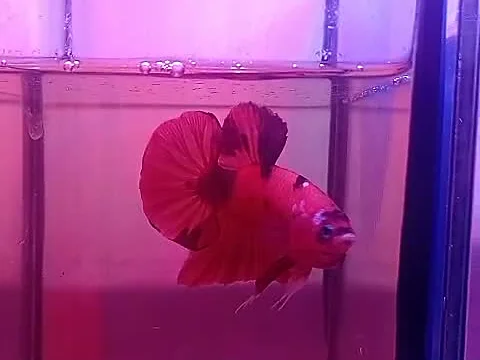
This red halfmoon is from my own clip, filmed in a divided tank. You can see the divider panel on the right side of the frame. With his fins spread this wide, you can see why soft decor and gentle flow matter so much in a betta tank.
Size per betta. Give each betta at least 5 gallons of space. A 10 gallon tank split in half is the smallest divided setup that really works, and a 20 gallon long split into two or three sections is better.
A divider that actually holds. Bettas can squeeze through surprisingly small gaps and jump over dividers that don’t reach the lid. Use a divider that fits snugly against the glass and touches or nearly touches the lid. Check the edges for gaps after you fill the tank, since the glass can bow slightly.
Water flow on both sides. A divider has holes or mesh so water moves through it, but the filter often sits on one side. Make sure both sections get filtered water and heat. A sponge filter in each section, or a single heater placed near the divider with gentle flow across both sides, solves this.
Visual barriers. Two males that can see each other all day will flare constantly. A little flaring is healthy exercise, but nonstop flaring is stressful. An opaque or frosted divider, or dense plants along a clear one, gives each fish privacy.
Have a plan B. If a betta keeps ramming the divider or one fish stops eating, separate them fully. Some bettas never settle next to a rival.
Common betta tank problems
Torn or shrinking fins. Ragged edges can come from sharp decor, fin biting from boredom or stress, or fin rot, a bacterial infection linked to poor water. Remove anything that fails the pantyhose test, test your water, and do extra water changes. Fin rot that keeps spreading or reaches the body needs treatment.
Betta lying at the bottom. First check the thermometer. Cold water is the most common cause of a lazy betta. Then test for ammonia and nitrite. Some bettas, especially long-finned types, simply like resting on leaves and decor, so a betta that perks up at feeding time is usually fine.
Bloated belly. Usually overfeeding or constipation. Skip food for a day or two, then offer a little daphnia. If the scales stick out like a pinecone, that’s dropsy, which is serious and needs fast action.
White spots. Small white dots like grains of salt are usually ich. Raise the temperature slowly to about 82 F and use an ich treatment safe for the other animals in your tank. Many ich medications are harmful to shrimp and snails, so read the label.
Gold or rusty dust on the body. This can be velvet, a parasite that shows up best with a flashlight. It spreads quickly and needs treatment right away.
Betta keeps jumping or hiding at the top. Often a sign of poor water or too much current. Test the water and turn down the filter.
Bubble nest on the surface. Good news. A male betta building a cluster of bubbles is a sign he feels comfortable. He doesn’t need a female to do this.
Algae taking over. Cut the light to 6 to 8 hours, avoid overfeeding, and add more plants. A snail helps too. Our algae eater guide covers which cleaners fit small tanks.
FAQ
What size tank does a betta fish need?
At least 5 gallons (19 liters) for one betta, with a heater and a gentle filter. A 10 gallon is even better and leaves room for a few peaceful tank mates.
Is a 2.5 gallon tank OK for a betta?
A betta can live in 2.5 gallons if the tank is heated, filtered and cleaned often, but it’s hard to keep stable. If you have the choice, a 5 gallon is far easier and safer.
Can a betta fish live in a bowl?
Not well. Most bowls are too small for a heater or filter, so the water gets cold and dirty quickly. A heated, filtered tank of 5 gallons or more is the healthy option.
Do betta fish need a heater?
Yes, in almost every home. Bettas are tropical fish that need water around 78 to 80 F (25.5 to 26.5 C), and most rooms are cooler than that for at least part of the year.
Do betta fish need a filter?
Yes. A filter keeps ammonia and nitrite at zero by growing beneficial bacteria. Choose a gentle one, like a sponge filter, because bettas struggle in strong current.
Can two bettas live in the same tank?
Not together. Two males will fight, and males and females usually can’t share a tank long term. You can keep two bettas in one tank with a secure divider that gives each fish at least 5 gallons.
How often should I clean a betta tank?
Change 20 to 30 percent of the water every week, and rinse the filter sponge in old tank water about once a month. Smaller tanks need more frequent water changes than larger ones.
What can live with a betta in a 5 gallon tank?
A nerite or mystery snail is the safest choice, and a few Amano shrimp often work too. Save fish tank mates for 10 gallons and up.
Final thoughts
The best betta fish tank isn’t fancy. It’s a 5 to 10 gallon tank with a lid, an adjustable heater, a gentle filter, a few soft plants and clean, cycled water. Set that up before you bring your betta home, and the daily work comes down to a little food and a quick look at the thermometer. If you’re still choosing a tank, our 5 gallon fish tank and 10 gallon fish tank guides go deeper into each size, and our best aquarium fish for beginners list has more ideas if you want a community tank later.