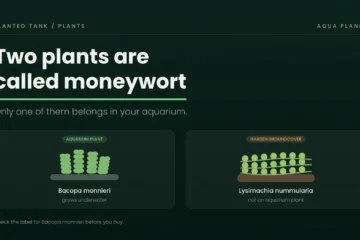
Bacopa monnieri aquarium moneywort compared with creeping Jenny garden groundcover

Moneywort Plant Care: How to Grow Bacopa monnieri in Your Aquarium

Quick answer: Moneywort (Bacopa monnieri) is one of the easiest stem plants you can grow. It has upright stems lined with small, bright green rounded leaves, it does not need CO2, and it grows in almost any tank with basic lighting. It sits best in the middle or background and reaches about 12 inches tall, sometimes more. The one thing most listings leave out: moneywort is usually grown above water before it is sold, so … Read more about Moneywort Plant Care: How to Grow Bacopa monnieri in Your Aquarium
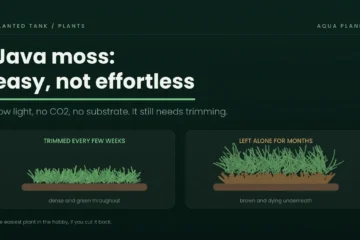
Java moss trimmed and dense compared with untrimmed moss going brown underneath Category: Plants That is twelve Aqua Planet articles now, all with featured images. Java moss is your biggest keyword yet at 9.9K US and KD 16, and the article has three of your own videos in it. One thing still open on it: the URL for the attach-with-thread video, so I can finalise that marked link. Java moss featured Image · WEBP  Java moss featured Image · PNG 

Java Moss Care Guide: How to Grow, Attach and Trim Taxiphyllum barbieri

Quick answer: Java moss is one of the easiest aquarium plants there is. It grows in low light, needs no CO2 and no substrate, tolerates roughly 15 to 30°C (59 to 86°F) and a wide pH range, and attaches itself to wood and rock with rhizoids rather than roots. You tie or glue it in place and leave it. The one thing nobody warns you about is trimming. Left alone, it grows into a thick … Read more about Java Moss Care Guide: How to Grow, Attach and Trim Taxiphyllum barbieri

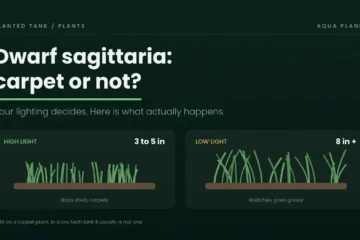
Dwarf sagittaria compared under high light and low light, showing it stays short or stretches tall

Dwarf Sagittaria Care: The Complete Guide (Sagittaria subulata)

Quick answer Dwarf sagittaria (Sagittaria subulata) is a hardy, grass-like aquarium plant that spreads by runners and grows well without CO2. It tolerates a wide range of conditions, roughly 20 to 28°C (68 to 82°F) and pH 5.0 to 8.0, and grows in sand or gravel provided it gets nutrients from root tabs or an enriched substrate. The one thing most listings do not tell you: its height depends on light. Under strong light it … Read more about Dwarf Sagittaria Care: The Complete Guide (Sagittaria subulata)

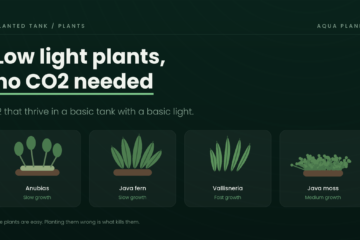
Low light aquarium plants that need no CO2: Anubias, Java fern, Vallisneria and Java moss

Low Light Aquarium Plants: 12 That Thrive Without CO2

Quick answer The best low light aquarium plants are Anubias, Java fern, Bucephalandra, Java moss, Cryptocoryne, Amazon sword, Vallisneria, hornwort, Anacharis, water wisteria, guppy grass and floating plants like frogbit. None of them need CO2 injection. They grow more slowly than high tech plants, which is the trade off, and in return they tolerate basic lighting, imperfect maintenance and beginner mistakes. The most common reason these plants still die is not lighting, it is being … Read more about Low Light Aquarium Plants: 12 That Thrive Without CO2

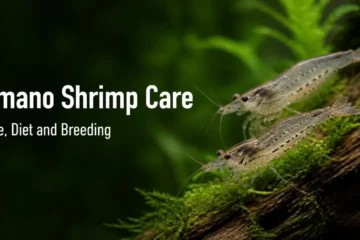
Amano shrimp grazing on moss-covered driftwood in a planted aquarium

Amano Shrimp Care: Size, Diet, Breeding and the Caridina Japonica Name

Quick answer: The Amano shrimp (Caridina multidentata, sold for years as Caridina japonica) is one of the best algae-grazing shrimp you can add to a freshwater tank. It’s hardy, peaceful and bigger than most aquarium shrimp, around 1 to 2 inches, and it spends all day picking soft algae, biofilm and leftover food off plants and decor. Keep a small group in a mature, cycled tank of 10 gallons or more, feed them a little … Read more about Amano Shrimp Care: Size, Diet, Breeding and the Caridina Japonica Name

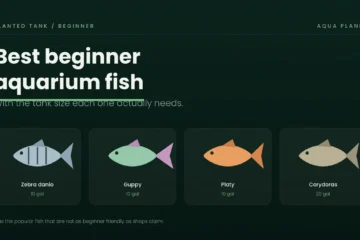
Beginner aquarium fish with tank sizes: zebra danio, guppy, platy and corydoras

Best Aquarium Fish for Beginners: 12 Hardy Fish That Actually Work

Quick answer: The best aquarium fish for beginners are small, hardy species that handle normal tap water and a few early mistakes: zebra danios, platies, male guppies, corydoras catfish, harlequin rasboras, ember tetras, cherry barbs, white cloud minnows, a betta on its own, and honey gouramis. The thing most people get wrong is thinking the fish is the hard part. Most beginner fish die from an uncycled tank, overfeeding or too many fish too fast, … Read more about Best Aquarium Fish for Beginners: 12 Hardy Fish That Actually Work

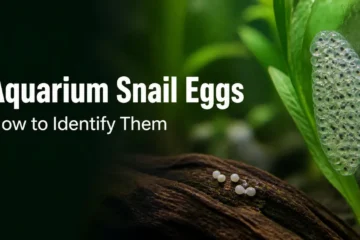
Clear jelly snail egg clutch on aquarium glass beside a plant leaf

Aquarium Snail Eggs: What They Look Like in a Fish Tank and What to Do

Quick answer: Most aquarium snail eggs fall into three looks. A clear jelly blob stuck underwater on glass or a leaf is from a pest snail like a bladder, pond or ramshorn snail, and it hatches in one to three weeks. Tiny hard white dots like sesame seeds are nerite snail eggs, and they never hatch in freshwater. A pale pink, cream or white clump stuck above the waterline is a mystery snail clutch. If … Read more about Aquarium Snail Eggs: What They Look Like in a Fish Tank and What to Do

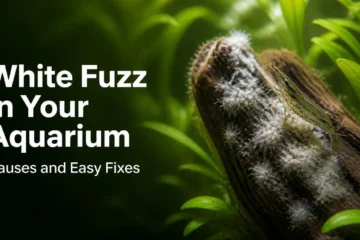
Amano shrimp grazing on white fuzzy biofilm on aquarium driftwood

White Fuzz on Aquarium Plants and Driftwood: What It Is and How to Get Rid of It

Quick answer: White fuzz on aquarium plants or new driftwood is almost always a harmless biofilm or water mold. Bacteria and fungi feed on sugars leaching out of fresh wood and on decaying bits of plant, and it looks like soft white cotton or slimy cobwebs. It won’t hurt your fish, shrimp or healthy plants. On new driftwood it usually peaks in the first one to three weeks and fades within about four to eight. … Read more about White Fuzz on Aquarium Plants and Driftwood: What It Is and How to Get Rid of It

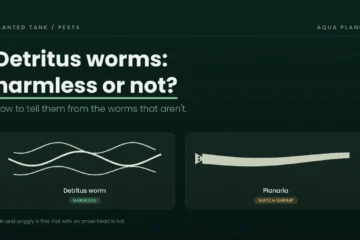
Detritus worm and planaria compared, showing which aquarium worm is harmless

Detritus Worms in Aquarium: Are They Harmful and How to Get Rid of Them

Detritus worms are tiny, thin, white to tan segmented worms that live in your substrate and eat leftover food and waste. They’re harmless to fish, shrimp, snails, plants and people, and a small number in the gravel is a normal sign of a living tank. You only notice them when there’s a population boom, usually from overfeeding or a dirty substrate, or when low oxygen drives them out onto the glass and into the water. … Read more about Detritus Worms in Aquarium: Are They Harmful and How to Get Rid of Them

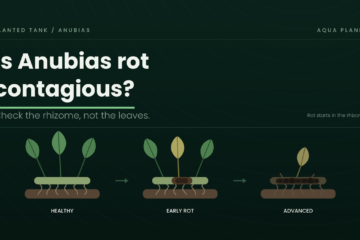
Three Anubias plants showing rhizome rot progression from healthy to advanced

Anubias Rot: Is It Contagious and How to Save Your Plant

Quick answer: Anubias rot often looks contagious. Many keepers lose one Anubias after another in the same tank over a few days or weeks, but no one has confirmed what causes it, so nobody can say for sure how it spreads. The safe approach is to treat it as contagious: take the plant out, cut the rhizome back into firm, healthy tissue with a margin, sterilise your scissors, and check your other Anubias every week. … Read more about Anubias Rot: Is It Contagious and How to Save Your Plant