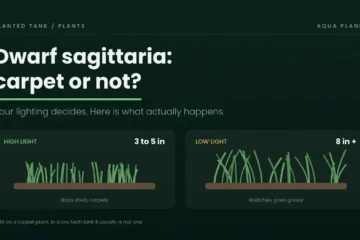
Dwarf sagittaria compared under high light and low light, showing it stays short or stretches tall

Dwarf Sagittaria Care: The Complete Guide (Sagittaria subulata)

Quick answer Dwarf sagittaria (Sagittaria subulata) is a hardy, grass-like aquarium plant that spreads by runners and grows well without CO2. It tolerates a wide range of conditions, roughly 20 to 28°C (68 to 82°F) and pH 5.0 to 8.0, and grows in sand or gravel provided it gets nutrients from root tabs or an enriched substrate. The one thing most listings do not tell you: its height depends on light. Under strong light it Read more
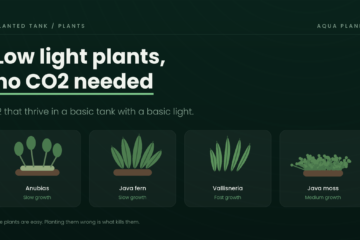
Low light aquarium plants that need no CO2: Anubias, Java fern, Vallisneria and Java moss

Low Light Aquarium Plants: 12 That Thrive Without CO2

Quick answer The best low light aquarium plants are Anubias, Java fern, Bucephalandra, Java moss, Cryptocoryne, Amazon sword, Vallisneria, hornwort, Anacharis, water wisteria, guppy grass and floating plants like frogbit. None of them need CO2 injection. They grow more slowly than high tech plants, which is the trade off, and in return they tolerate basic lighting, imperfect maintenance and beginner mistakes. The most common reason these plants still die is not lighting, it is being Read more

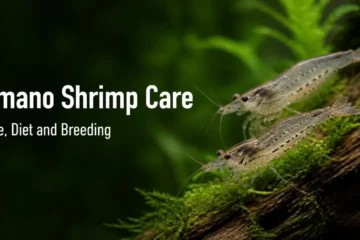
Amano shrimp grazing on moss-covered driftwood in a planted aquarium

Amano Shrimp Care: Size, Diet, Breeding and the Caridina Japonica Name

Quick answer: The Amano shrimp (Caridina multidentata, sold for years as Caridina japonica) is one of the best algae-grazing shrimp you can add to a freshwater tank. It’s hardy, peaceful and bigger than most aquarium shrimp, around 1 to 2 inches, and it spends all day picking soft algae, biofilm and leftover food off plants and decor. Keep a small group in a mature, cycled tank of 10 gallons or more, feed them a little Read more

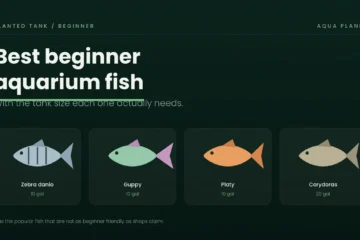
Beginner aquarium fish with tank sizes: zebra danio, guppy, platy and corydoras

Best Aquarium Fish for Beginners: 12 Hardy Fish That Actually Work

Quick answer: The best aquarium fish for beginners are small, hardy species that handle normal tap water and a few early mistakes: zebra danios, platies, male guppies, corydoras catfish, harlequin rasboras, ember tetras, cherry barbs, white cloud minnows, a betta on its own, and honey gouramis. The thing most people get wrong is thinking the fish is the hard part. Most beginner fish die from an uncycled tank, overfeeding or too many fish too fast, Read more

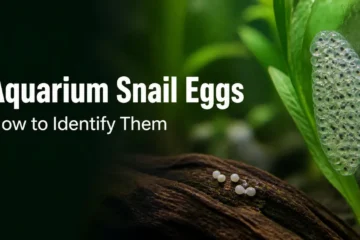
Clear jelly snail egg clutch on aquarium glass beside a plant leaf

Aquarium Snail Eggs: What They Look Like in a Fish Tank and What to Do

Quick answer: Most aquarium snail eggs fall into three looks. A clear jelly blob stuck underwater on glass or a leaf is from a pest snail like a bladder, pond or ramshorn snail, and it hatches in one to three weeks. Tiny hard white dots like sesame seeds are nerite snail eggs, and they never hatch in freshwater. A pale pink, cream or white clump stuck above the waterline is a mystery snail clutch. If Read more

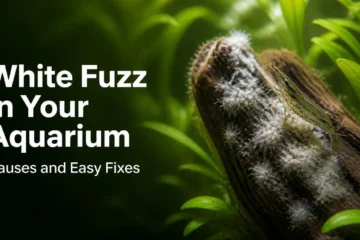
Amano shrimp grazing on white fuzzy biofilm on aquarium driftwood

White Fuzz on Aquarium Plants and Driftwood: What It Is and How to Get Rid of It

Quick answer: White fuzz on aquarium plants or new driftwood is almost always a harmless biofilm or water mold. Bacteria and fungi feed on sugars leaching out of fresh wood and on decaying bits of plant, and it looks like soft white cotton or slimy cobwebs. It won’t hurt your fish, shrimp or healthy plants. On new driftwood it usually peaks in the first one to three weeks and fades within about four to eight. Read more

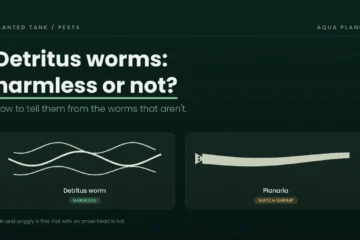
Detritus worm and planaria compared, showing which aquarium worm is harmless

Detritus Worms in Aquarium: Are They Harmful and How to Get Rid of Them

Quick answer: Detritus worms are tiny, thin, white to tan segmented worms that live in your substrate and eat leftover food and waste. They’re harmless to fish, shrimp, snails, plants and people, and a small number in the gravel is a normal sign of a living tank. You only notice them when there’s a population boom, usually from overfeeding or a dirty substrate, or when low oxygen drives them out onto the glass and into Read more

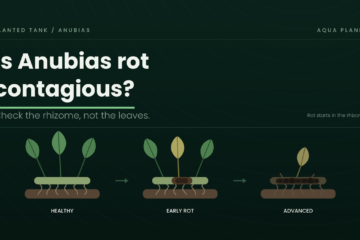
Three Anubias plants showing rhizome rot progression from healthy to advanced

Is Anubias Rot Contagious? What I Did When Mine Got It

Quick answer Most keepers who have dealt with Anubias rot report that it spreads from one plant to another, often losing several Anubias in a row over a few weeks. The cause has never been firmly identified, so nobody can say for certain what is spreading or how. The practical approach is to treat it as though it is contagious: move the affected plant out, cut the rhizome back into firm clean tissue, sterilise your Read more

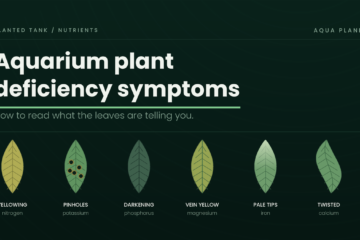
Six aquarium plant leaves showing nutrient deficiency symptoms: yellowing, pinholes, darkening, vein yellowing, pale tips and twisted growth

Aquarium Plant Deficiency Symptoms Explained

Quick answer Aquarium plant deficiency symptoms are read by looking at which leaves are damaged and what the damage looks like. Problems on old leaves usually mean a mobile nutrient is running short: yellowing old leaves can point to nitrogen deficiency, small pinholes can point to potassium, and dark or blackening leaves can point to phosphorus. Problems on new leaves point instead towards an immobile nutrient: pale or yellow new growth can point to iron, Read more

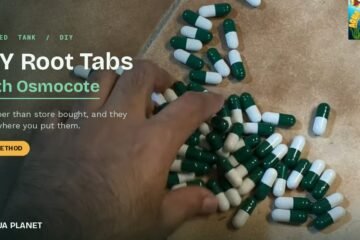
Homemade aquarium root tabs made from gel capsules filled with Osmocote

DIY Root Tabs for Aquarium Plants: My Osmocote Method

Quick answer To make DIY root tabs for aquarium plants, fill empty gel capsules with Osmocote controlled release fertilizer, poke a few small holes in the capsule with a needle, then press the capsule under water so it fills and sinks. Push each tab deep into the substrate near the roots of heavy root feeders like Cryptocoryne, Echinodorus and Amazon sword. A bag of Osmocote and a pack of capsules makes hundreds of tabs for Read more