Quick answer
Most keepers who have dealt with Anubias rot report that it spreads from one plant to another, often losing several Anubias in a row over a few weeks. The cause has never been firmly identified, so nobody can say for certain what is spreading or how. The practical approach is to treat it as though it is contagious: move the affected plant out, cut the rhizome back into firm clean tissue, sterilise your scissors before touching anything else, and watch your remaining Anubias closely for soft spots.
Anubias is sold as the plant you cannot kill. Low light, no CO2, attach it to a rock and forget about it.
Then one day a leaf comes away in your hand with no resistance at all, and the rhizome underneath is soft and dark.
That is rhizome rot, and the question everybody asks next is whether the rest of their Anubias is about to go the same way. This is what I found, what I did with mine, and what is actually known versus what is repeated.
What Anubias rhizome rot looks like
The rhizome is the thick horizontal stem that the leaves and roots grow out of. On a healthy Anubias it is firm, pale green, and sits above the substrate attached to wood or rock.
Rot starts there, not in the leaves. That is the single most useful thing to know, because most people look at the yellowing leaf and miss what is happening underneath it.
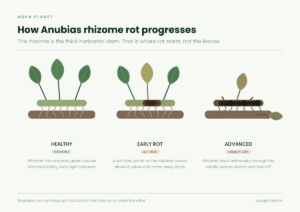
Early on, you get a soft patch on the rhizome, usually darker than the tissue around it. Press it gently and it gives where the rest of the rhizome does not. Leaves growing from that section start yellowing and detach with almost no pull.
Later, the soft section turns dark brown or black and goes mushy. The rhizome can break apart if you lift the plant. Leaves come off on their own and float around the tank.
The tell that separates rot from everything else is the texture. Nutrient problems and low light change the colour of leaves but the rhizome stays firm. With rot, the rhizome itself fails.
So is it contagious?
Here is the honest position, because the sources disagree and I would rather show you that than pick the answer that sounds more confident.
What keepers report: the forums are remarkably consistent on this. People describe losing one Anubias after another, sometimes at roughly one plant at a time over consecutive days, in tanks where everything else looked fine. That pattern comes up again and again from different people in different tanks.
What is actually established: not much. Aquarium Co-Op’s position is that no definitive cause has been identified, and the working theories are bacterial or fungal. If the cause is not confirmed, then strictly speaking neither is the mechanism of spread.
How I would put it: the observed pattern strongly suggests something transmissible between plants in the same water. It has not been formally identified. Treating it as contagious costs you very little and protects you if it is, so that is what I did, and my own case is further down.
What causes it
Nobody knows for certain, and any page telling you otherwise is more confident than the evidence supports.
The theories you will run into:
- Bacterial or fungal infection. The most commonly cited, and it fits the spreading pattern.
- Damage during shipping or planting. A bruised or cut rhizome giving something an entry point.
- Burying the rhizome. A rhizome pushed into substrate rots reliably. This one is not a mystery, it is a planting mistake, and it may be behind a fair share of cases blamed on disease.
- Poor water quality or unstable parameters. Often mentioned, rarely demonstrated as the direct cause.
The buried rhizome one is worth checking first, because it is the only cause on that list you can definitely rule in or out by looking. If any part of the rhizome is under the substrate, that is very likely your answer, and it is fixable.
What I did when mine got it
When one of my Anubias got rot, I took it out of the display tank and kept it separately rather than leaving it in with the others. Then I cut the rotten section of rhizome away and left the plant to recover on its own.
Separating it first is the part I would repeat. If this does spread between plants, leaving an affected one sitting in the tank while you decide what to do is the one thing you clearly should not be doing, and isolating it costs you nothing if it turns out not to spread at all.
None of my other Anubias got it. They stayed healthy the whole time.
I want to be careful about what that does and does not prove. One plant in one tank is a single case, not evidence. It is also impossible for me to separate the two explanations: either pulling it out stopped it spreading, or it was never going to spread in my tank in the first place. I cannot tell you which.
What I can say is that isolating and cutting is cheap, fast and low risk, and in my case nothing else was lost.
The cut plant is still going. It has not been long enough for me to call it either way, and I would rather say that than claim a recovery I have not actually seen yet. I will update this section when I know.
I also did not photograph the rhizome at each stage, which is why the diagram above is an illustration rather than my plant.
How to treat it, step by step
1. Take the plant out. Lift it clear of the tank rather than trying to treat it in place. If it is tied or glued to wood, take the wood out with it.
2. Find where the firm tissue starts. Feel along the rhizome. You are looking for the boundary between soft and solid.
3. Cut well past that boundary. Not right at the edge of the damage. Go into clean firm tissue with some margin, because the visible rot and the actual extent are not always the same thing. Losing an extra centimetre of healthy rhizome is a much better outcome than leaving infected tissue behind.
4. Throw the rotten section away. Not into another tank, not into a quarantine tank with other plants.
5. Sterilise your scissors before you touch anything else. This is the step people skip. If this is transmissible at all, your own tools are the most obvious way to carry it from one plant to the next.
6. Keep the cut section separate for a few weeks if you can. New growth from the remaining rhizome is your sign that you cut far enough.
7. Check your other Anubias. Run a finger along each rhizome looking for soft spots. Do this weekly for a while rather than once.
A note on hydrogen peroxide dips, since they come up constantly in the forums. Some keepers swear by them, others report no difference. Given that the cause itself is unconfirmed, I would not present a dip as a proven treatment. Removing the affected tissue is the part that is generally agreed on.
How to reduce the risk
Never bury the rhizome. Attach Anubias to wood, rock or a decoration. If it is in the substrate, only the roots go under. This applies to Java fern, Bucephalandra and mosses too, and it is the most common way people kill plants that are otherwise very hard to kill.
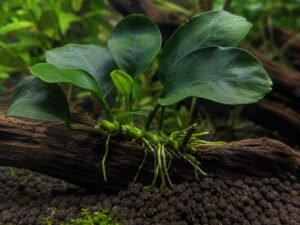
Quarantine new plants if you can. A couple of weeks in a separate container is not practical for everyone, but if you have had rot before it is worth doing.
Handle new plants gently. Avoid crushing the rhizome when you attach it. Thread or gel glue on the underside is kinder than tying it tight.
Do not over-fertilise the substrate around them. Anubias feeds through its leaves, not its roots, so there is no benefit to putting root tabs underneath it. Save those for your Cryptocoryne and swords.
Keep some flow around it. Anubias in a completely dead corner with detritus building up around the rhizome seems to fare worse, though I am describing a pattern rather than a proven mechanism.
Things that look like rot and are not
| What you see | Rhizome | Likely cause | What to do |
|---|---|---|---|
| Rhizome soft or mushy, leaves fall off | Soft, dark | Rhizome rot | Isolate and cut back now |
| Leaves soft and transparent, plant recently added | Firm | New plant melt | Leave it alone |
| Leaves pale or yellow, plant otherwise solid | Firm | Nutrient deficiency | Dose fertiliser, judge on new growth |
| One old leaf yellowing, new growth healthy | Firm | Normal ageing | Nothing |
New plant melt. A recently added Anubias dropping a couple of leaves while it adjusts to being underwater is normal, and it is not the same thing. The difference is the rhizome. If the rhizome is firm, it is melt rather than rot.
Yellowing leaves with a firm rhizome. That is more likely to be a nutrient issue. Anubias is slow growing so it takes a long time to show it, but pale or yellowing leaves on an otherwise solid plant point towards a deficiency instead.
Old leaves dying off. Anubias sheds its oldest leaves eventually. One yellow leaf at the back of a plant that is putting out new growth is normal ageing.
Green spot algae on the leaves. Ugly, harmless, unrelated to the rhizome.
Mistakes to avoid
Waiting to see if it improves. It does not. Every day you wait is more rhizome lost, and if it does spread, more exposure for the rest of your plants.
Cutting right at the edge of the rot. The damage usually runs further than it looks.
Using the same scissors on your other plants straight afterwards. Sterilise first.
Putting the affected plant in another tank to recover. You may just be moving the problem.
Assuming it must be your water. Anubias rot shows up in well-maintained tanks with good parameters. Blaming water quality can send you chasing numbers that were never the issue.
FAQ
[faq]
Q: Is Anubias rot contagious?
A: Keepers consistently report it spreading between Anubias in the same tank. The cause has not been confirmed, so this is based on observed pattern rather than established science. Treating it as contagious is the safer approach.
Q: Can Anubias recover from rhizome rot?
A: Yes, if there is enough firm rhizome left after you cut away the damage. New growth from the remaining section is your confirmation. If the whole rhizome has gone soft, the plant is usually lost.
Q: Will it spread to my Java fern or Bucephalandra?
A: Reports of it spreading are almost entirely between Anubias. That said, since the cause is unidentified, nobody can rule it out with confidence.
Q: How long does it take to spread?
A: People describe losing plants over days to weeks rather than months. That is why acting quickly matters more here than with most plant problems.
Q: Should I tear the tank down?
A: No. Remove the affected plant, cut it back, sterilise your tools and monitor the rest. There is no evidence that a full reset is needed.
Q: How do I tell rot from melt?
A: Feel the rhizome. Firm rhizome with leaf loss is melt or shedding. Soft or mushy rhizome is rot.
[/faq]
Final word
Check the rhizome, not the leaves. That is the whole diagnosis in one line.
If it is soft, cut back into clean tissue with margin, sterilise your scissors, and keep an eye on your other Anubias. The cause is still unsettled, and anyone telling you they know exactly what it is has gone further than the evidence goes. But the practical response is the same either way, and it costs you very little to act as though it spreads.
0 Comments