Quick answer: A standard 10 gallon fish tank measures 20 x 10 x 12 inches (51 x 25 x 30 cm), holds about 38 liters, weighs around 11 pounds empty and roughly 100 to 115 pounds once it’s filled with water, gravel and decor. It’s a good size for one betta, a small school of 6 to 8 nano fish like galaxy rasboras or ember tetras, a group of pygmy corydoras, or a shrimp colony. What most people get wrong is treating it as a “starter” tank for any fish. Goldfish, angelfish, tiger barbs and plecos all outgrow it, and the old “one inch of fish per gallon” rule overstocks small tanks fast.
10 gallon fish tank at a glance
| Detail | Standard 10 gallon tank |
|---|---|
| Dimensions | 20 x 10 x 12 in (51 x 25 x 30 cm) |
| Outside size with trim | About 20.25 x 10.5 x 12.6 in, depending on brand |
| Volume | About 10 US gallons (38 L) to the brim, 8 to 9 gallons of real water after substrate and decor |
| Empty weight | About 10 to 13 lb (5 to 6 kg) for glass |
| Filled weight | About 100 to 115 lb (45 to 52 kg) |
| Footprint | 200 sq in, fits a sturdy desk, dresser or small stand |
| Heater | 25 to 50 W |
| Filter | Rated for 10 gallons, about 40 to 100 gallons per hour (GPH) |
| Light | A 20 in LED fixture |
| Weekly water change | 25 to 30 percent, about 2.5 to 3 gallons |
| Best for | Betta, nano schooling fish, dwarf corydoras, shrimp and snails |
| Skill level | Beginner friendly if stocked lightly and cycled first |
How big is a 10 gallon fish tank? Dimensions by tank style
Most tanks sold as “10 gallon” in the US are the classic rectangle. A few other shapes hold about the same water but fit different spaces.
| Tank style | Typical size (L x W x H) | Metric | Good for |
|---|---|---|---|
| Standard 10 gallon | 20 x 10 x 12 in | 51 x 25 x 30 cm | Most fish, easiest to find lids, lights and stands |
| Cube 10 gallon | About 13 x 13 x 14 in | About 33 x 33 x 36 cm | Shrimp, a betta, planted nano scapes |
| Rimless nano (about 9 to 10 gal) | About 18 x 10 x 12 in | 45 x 27 x 30 cm | Planted tanks and shrimp, looks clean on a desk |
| Bow front 10 gallon | About 20 x 10 x 13 in, curved front | 51 x 25 x 33 cm | Display tanks. Harder to fit lids and lights |
Here’s the honest part most size guides leave out. The number on the box is the volume to the very top of the glass. Once you add 1 to 2 inches of substrate, rocks and wood, and leave a gap under the lid, a 10 gallon tank really holds about 8 to 9 gallons of water. That’s why stocking lightly matters so much in small tanks. You can check your own tank with our aquarium volume calculator. The math is simple: 20 x 10 x 12 inches is 2,400 cubic inches, divided by 231 gives 10.4 US gallons.
10 gallon vs 5 gallon vs 20 gallon: which should you buy?
| Detail | 5 gallon | 10 gallon | 20 gallon long |
|---|---|---|---|
| Typical size | 16 x 8 x 10 in | 20 x 10 x 12 in | 30 x 12 x 12 in |
| Filled weight | About 55 to 60 lb | About 100 to 115 lb | About 225 lb |
| Fish options | One betta or shrimp | Betta, nano schools, dwarf cories, shrimp | Most small community fish |
| Water stability | Swings fast | Fair | Much more forgiving |
| Best for | Single betta or shrimp only | Small desk tanks and nano setups | First community tank |
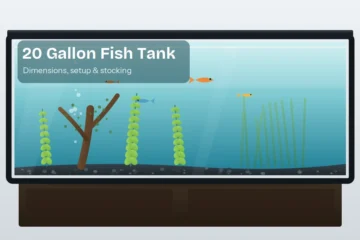
If you have the space and want a mixed community, a 20 gallon is the easier tank to keep stable. Our 20 gallon fish tank guide covers that size. If you want a desk tank, a betta setup or a shrimp tank, a 10 gallon is a great choice.
How many fish in a 10 gallon tank?
For small nano fish that stay under 1.5 inches, plan on roughly 6 to 10 fish total in a well-filtered, planted 10 gallon. For a betta, it’s one betta plus a few snails or a small group of bottom dwellers.
Why the inch per gallon rule fails. It counts length, not body mass or activity. Ten 1 inch ember tetras and one 10 inch pleco are both “10 inches,” but the pleco makes many times more waste and has no room to turn around. Use adult size, swimming space and group size instead.
Things that let you stock a little more: live plants, a good filter, weekly water changes and peaceful fish that use different levels of the tank.
Things that mean stock less: no plants, a weak kit filter, messy eaters, or less time for maintenance.
Our aquarium stocking calculator gives a quick check before you buy.
Best fish for a 10 gallon tank
| Fish | Adult size | How many in 10 gal | Notes |
|---|---|---|---|
| Betta | 2.5 to 3 in | 1 male | The classic 10 gallon fish. Needs a heater and gentle flow |
| Galaxy rasbora (celestial pearl danio) | About 1 in | 6 to 8 | Shy, does best in a planted tank |
| Ember tetra | About 0.8 in | 8 to 10 | Bright orange, peaceful, great with shrimp |
| Chili rasbora | About 0.8 in | 8 to 10 | Tiny and colorful, needs plants and calm water |
| Endler’s livebearer | About 1 in | 4 to 6 males | Keep males only or the tank fills with babies |
| Pygmy corydoras | About 1 in | 6 to 8 | Swim mid-water as a group. Use sand or smooth gravel |
| Honey gourami | About 2 in | 1 | A calm centerpiece fish for a planted 10 gallon |
| Scarlet badis | About 0.8 in | 1 male, or 1 male and 2 females | Needs live or frozen food. Will eat baby shrimp |
| Sparkling gourami | About 1.5 in | 3 to 4 | Makes croaking sounds. Likes still water and plants |
| Neon tetra | About 1.5 in | 6, but 15 to 20 gal is better | Active swimmers. Possible, not ideal |
For more beginner-friendly options by tank size, see our best aquarium fish for beginners guide.
Shrimp and snails for a 10 gallon tank
Cherry shrimp. A 10 gallon is a perfect shrimp tank. Start with 10 to 15, and they’ll breed to fill the tank.
Amano shrimp. 2 to 4 are great algae cleaners in a 10 gallon.
Nerite snails. 1 to 2 for algae, and they can’t breed in freshwater.
Mystery snail. 1 is enough. They’re big and make a lot of waste for a small tank.
Assassin snails. 1 or 2 if you have a pest snail problem.
Shrimp molts are normal in a shrimp tank. If you find an empty shell, our shrimp molting guide shows how to tell a molt from a dead shrimp.
10 gallon tank stocking ideas
| Setup | Stocking |
|---|---|
| Betta tank | 1 betta, 1 nerite snail, optional 6 pygmy corydoras |
| Nano community | 8 ember tetras or chili rasboras, 6 pygmy corydoras, 1 nerite snail |
| Planted centerpiece | 1 honey gourami, 6 to 8 galaxy rasboras, a few Amano shrimp |
| Shrimp tank | 10 to 15 cherry shrimp, 1 nerite snail, lots of moss |
| Live food tank | 1 male and 2 female scarlet badis, plants, no shrimp |
Pick one setup and stick to it. Mixing two of these is the fastest way to overstock a 10 gallon.
Fish to avoid in a 10 gallon tank
| Fish | Why not | Minimum tank |
|---|---|---|
| Goldfish | Grow large and produce lots of waste | 20 gal or more for one fancy goldfish, ponds for common goldfish |
| Angelfish | Grow 6 in long and tall | 30 gal or more |
| Tiger barbs | Fast, nippy schooling fish that need space | 20 gal long or more |
| Bristlenose pleco and other plecos | Too big and messy for 10 gallons | 20 to 25 gal or more |
| Zebra danios | Very active, need swimming length | 20 gal long |
| Black skirt tetras | Larger and nippy in groups | 20 gal or more |
| Dwarf gourami | Can be aggressive in small tanks | 15 to 20 gal |
| Cichlids, oscars and big catfish | Far too large | Much bigger tanks |
Best equipment for a 10 gallon fish tank
Filter. Choose a filter rated for 10 gallons, roughly 40 to 100 GPH. A hang-on-back filter works for most tanks. A sponge filter is the better pick for bettas, shrimp and fry, since the flow is gentle and babies can’t get sucked in.
Heater. 25 to 50 watts. A 50 W adjustable heater is the safer choice in cool rooms. Most tropical fish want 74 to 80 F (23 to 27 C).
Light. A 20 inch LED is enough for low light plants like anubias, java moss and hornwort. Run it 6 to 8 hours a day.
Lid. Bettas, shrimp and many nano fish can jump or climb out. A lid also slows evaporation.
Substrate. About 10 to 15 lb of gravel or sand for a 1.5 to 2 inch layer. Use sand for corydoras.
Test kit and water conditioner. Small tanks change fast, so test ammonia, nitrite and nitrate until the tank is stable.
About 10 gallon kits. Kits are cheap and easy, but the included filter and light are often basic. A kit is fine to start, just upgrade the light if you want plants to grow, and add a sponge filter for a betta or shrimp.
10 gallon fish tank stand: what can hold it?
A filled 10 gallon weighs about 100 to 115 pounds, about the same as an adult person. A solid wood dresser, a sturdy desk or a stand made for aquariums is fine.
- Check it’s level. An uneven surface stresses the glass and the seams.
- Use the full base. The whole bottom frame of the tank should rest on the surface, with no overhang.
- Avoid weak furniture. Particleboard shelves, thin tables and bookshelves can sag over time.
- Think about the spot. Keep it out of direct sunlight to avoid algae, and near an outlet.
How to set up a 10 gallon fish tank
- Place the stand and tank where they’ll stay. Moving a full tank is risky.
- Rinse and add substrate, sloped a little higher at the back.
- Add rocks, wood and plants. Live plants help a lot in small tanks.
- Fill with dechlorinated water at room temperature, poured over a plate to avoid stirring up the substrate.
- Install the filter and heater, then turn them on.
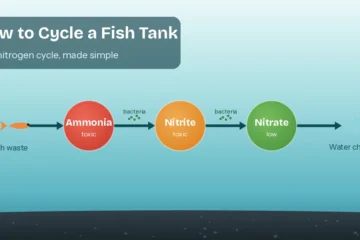
- Cycle the tank for about 3 to 6 weeks before adding fish. Our how to cycle a fish tank guide walks you through it.
- Add fish slowly, a few at a time, a week or two apart.
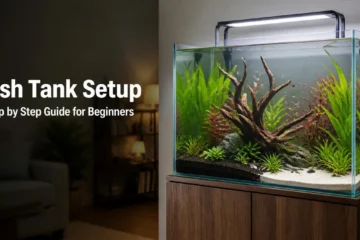
For a full step-by-step with photos, see our fish tank setup guide.
Water parameters and maintenance
| Parameter | Target for most nano tanks |
|---|---|
| Temperature | 74 to 80 F (23 to 27 C), lower for cherry shrimp is fine |
| pH | 6.5 to 7.5 |
| Ammonia and nitrite | 0 ppm |
| Nitrate | Under 20 to 40 ppm |
| Water change | 25 to 30 percent weekly |
Our water change calculator shows how much to remove for your tank.
Common 10 gallon tank problems
Cloudy water in a new tank. Usually a bacterial bloom while the tank cycles. Don’t overfeed, and give it time. See our cloudy fish tank water guide.
Ammonia spikes. Too many fish too soon, or overfeeding. Feed less, change 30 to 50 percent of the water and add fish more slowly.
Temperature swings. Small tanks heat and cool fast. Use a heater with a thermostat and keep the tank away from windows and AC vents.
Algae everywhere. Light on too long or sunlight hitting the tank. Cut the light to 6 hours and add more plants. For stubborn algae, see our black beard algae guide.
Plants melting. Common in new tanks as plants adjust. Our plants melting guide explains what to do.
Strong current pushing fish around. The filter is too strong. Turn it down, aim the outflow at the glass, or switch to a sponge filter.
Fish dying after the first week. Usually the tank wasn’t cycled. Test the water and do water changes until ammonia and nitrite read zero.
FAQ
How big is a 10 gallon fish tank?
A standard 10 gallon tank is 20 inches long, 10 inches wide and 12 inches tall (51 x 25 x 30 cm). It holds about 38 liters.
How much does a 10 gallon fish tank weigh?
About 10 to 13 pounds empty and roughly 100 to 115 pounds when filled with water, substrate and decor.
How many fish can go in a 10 gallon tank?
About 6 to 10 small nano fish, like ember tetras, chili rasboras or galaxy rasboras, or one betta with a few snails or small bottom dwellers.
What fish can live in a 10 gallon tank?
Bettas, galaxy rasboras, ember tetras, chili rasboras, Endler’s livebearers, pygmy corydoras, honey gouramis, sparkling gouramis, cherry shrimp and nerite snails.
Is a 10 gallon tank good for beginners?
Yes, if you cycle it first and stock lightly. A 20 gallon is more forgiving, but a 10 gallon works well for a betta, a shrimp tank or a small nano school.
Can a goldfish live in a 10 gallon tank?
No. Goldfish grow large and make a lot of waste. A single fancy goldfish needs at least 20 gallons, and common goldfish need a pond or a very large tank.
What size heater and filter do I need for a 10 gallon tank?
A 25 to 50 watt heater and a filter rated for 10 gallons, about 40 to 100 gallons per hour. Use a sponge filter for bettas and shrimp.
How often should I clean a 10 gallon fish tank?
Change 25 to 30 percent of the water every week and rinse the filter sponge in old tank water about once a month.